For centuries, scholars have painstakingly worked to decode cuneiform, one of the world’s earliest writing systems. With over half a million unearthed tablets, the majority remain untranslated due to the sheer complexity of the script. Now, a groundbreaking AI-powered system called ProtoSnap, developed by researchers from Tel Aviv University, Ariel University, LMU, and Cornell University, is set to revolutionize cuneiform decipherment, making it faster and more accurate than ever before. This technology has the potential to expand our understanding of ancient Mesopotamian societies, shedding new light on their religion, economy, and social structures.
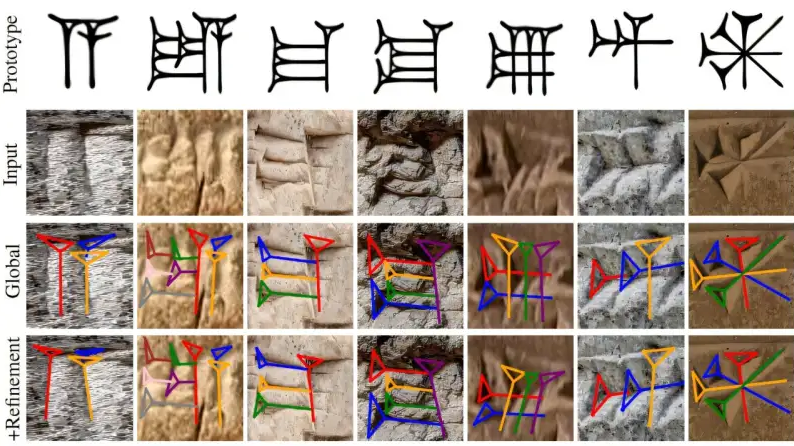
Deciphering cuneiform is a daunting challenge. The script, first developed by the Sumerians over 5,000 years ago, evolved over millennia, resulting in significant variations in character appearance across different time periods, regions, and individual scribes. Traditional optical character recognition (OCR) systems struggle with these inconsistencies, leading to errors that slow down the transcription process. ProtoSnap, however, offers a revolutionary solution by employing a generative AI model to align each cuneiform character with a prototype reference. This method effectively “snaps” the character into place, producing highly accurate copies that can then be fed into machine-learning models for transcription.
The impact of ProtoSnap is profound. By significantly improving character recognition, this AI system enhances the accuracy of cuneiform transcription, especially for rare or highly variable signs. By enforcing structural consistency in matches, the model ensures that the translated characters maintain their original configuration, solving a problem that has long hindered traditional OCR-based approaches. With thousands of tablets still waiting to be translated, ProtoSnap has the potential to increase the volume of deciphered texts tenfold, unlocking a treasure trove of historical information. This advancement will not only accelerate linguistic research but also enable large-scale analyses of ancient societies.
Understanding cuneiform texts is crucial to reconstructing the past. These inscriptions provide firsthand accounts of Mesopotamian life, detailing everything from legal contracts and trade records to religious rituals and royal decrees. By automating transcription, ProtoSnap allows scholars to analyze broader datasets, uncovering patterns and connections that were previously inaccessible due to the labor-intensive nature of manual translation.
The significance of this AI breakthrough extends beyond academic research. It holds immense potential for museum digitization projects, enabling institutions to digitally preserve and categorize vast collections of cuneiform artifacts. Additionally, ProtoSnap’s methodology could be adapted for other ancient scripts, such as Egyptian hieroglyphs or Mayan glyphs, further revolutionizing the field of archaeology.
Despite its remarkable capabilities, ProtoSnap is not a replacement for human expertise. Instead, it serves as a powerful tool to assist scholars, reducing the time required for translation and allowing researchers to focus on interpretation and contextual analysis. The fusion of artificial intelligence and historical linguistics is ushering in a new era of discovery, where the past becomes more accessible to the present.
As this technology continues to evolve, we stand on the brink of a major shift in historical studies. The ability to quickly and accurately decipher ancient texts could reshape our understanding of early civilizations, revealing insights into their beliefs, innovations, and interactions. With ProtoSnap, the secrets of Mesopotamia—and perhaps many other ancient cultures—are finally within reach.