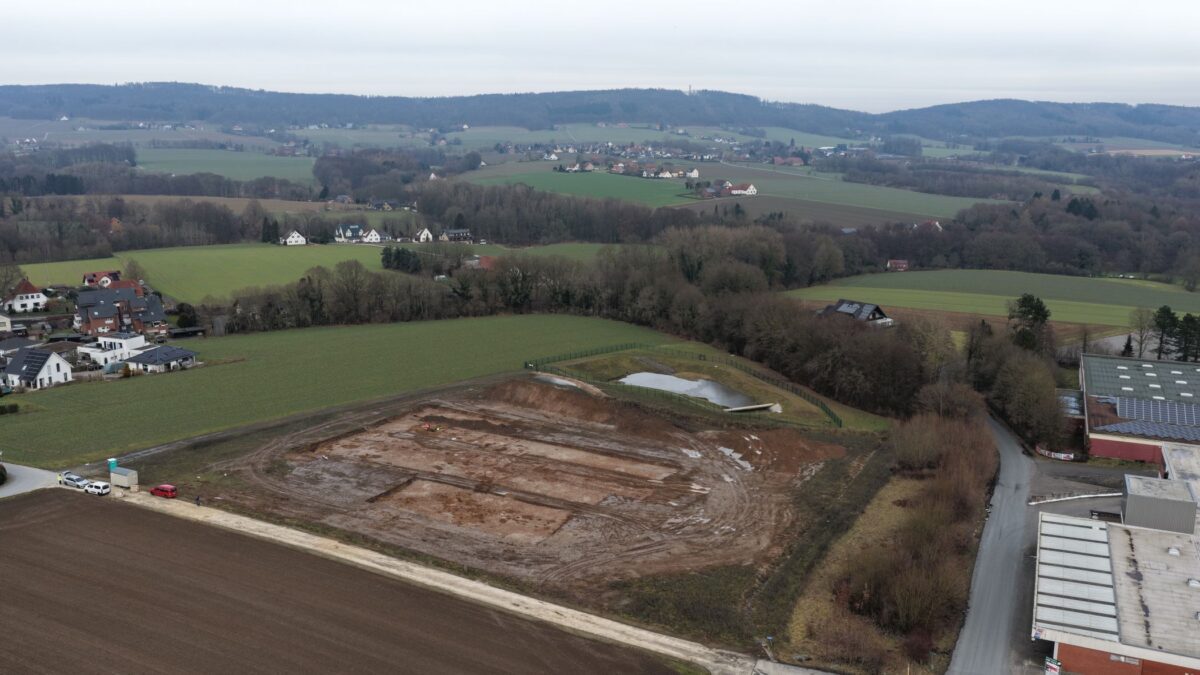
Imagine standing in a quiet town in Germany where modern life moves at a steady pace. The local municipality decides they need a new building to protect citizens from emergencies. Heavy earthmovers arrive on a crisp morning and begin scraping away the topsoil to lay a foundation. But instead of just unearthing common dirt and ordinary rocks, the machines reveal something completely unexpected. The work grinds to a sudden halt. What could possibly stop a massive modern construction project in its tracks and force everyone to look carefully into the damp mud?
The builders in the town of Hüllhorst were simply trying to prepare the ground for a brand new fire station. They never expected to crack open a time capsule that had been resting quietly beneath their feet for two thousand five hundred years. As local historians and archaeological experts rushed to the site, they quickly realized this was not merely a random scattering of old stones or a lost artifact. It was the footprint of an entire ancient settlement dating all the way back to the Iron Age.
This specific era in European history is fascinating. It was a time long before the Roman Empire expanded deep into these northern territories. The people who lived in this region were members of early Germanic tribes who thrived in dense forests and sweeping valleys. Unlike the Romans or the ancient Egyptians, these northern tribes did not leave behind grand written histories or towering stone monuments. Because of this absence of written records, everything we know about their daily struggles and triumphs comes entirely from what they accidentally left behind in the dirt.
Finding a residential settlement is an exceptionally rare and exciting event for researchers. Most of the famous ancient discoveries tend to be royal burials, religious sites, or hidden hoards of coins. While those finds are undeniably glamorous, they only show us how the wealthy elite lived or how they treated their dead. Settlements give us a true, unfiltered window into how ordinary families survived, cooked, and gathered. They show us the raw reality of ancient human existence.
But how do archaeologists actually see a wooden village that completely rotted away thousands of years ago? The science behind this is surprisingly elegant. When these ancient people built their homes, they drove massive timber posts deep into the earth to support heavy thatched roofs. The wood itself eventually decayed over the centuries, consumed by moisture and time. However, the dark organic material left behind by the rotting wood permanently stained the surrounding lighter soil. By carefully scraping away the modern dirt, researchers can map out these dark circular stains known as postholes.
These dark marks act just like a modern architectural blueprint. They show experts exactly where the exterior walls stood, where the doorways were located, and just how large the houses actually were. The structures uncovered in Hüllhorst were likely massive longhouses. In these impressive buildings, human families and their valuable livestock lived together under a single enormous roof. This shared living space was a brilliant survival strategy. The body heat generated by cattle and sheep helped keep the human inhabitants warm during the brutally cold and unforgiving northern winters. Imagine the smoky air inside those longhouses, the rich smell of wood fires burning constantly, and the soft sounds of animals moving just a few feet away from sleeping children.
As the excavation team dug deeper, they also found ancient pits originally used for storing food and eventually used for discarding waste. To a modern observer, ancient trash might seem completely useless. But to an archaeologist, these trash pits are absolute gold mines. They contain broken fragments of handmade pottery, discarded animal bones, and sometimes even lost daily tools. These tiny fragments tell intricate stories about what these ancient people ate, how they hunted, and how they crafted their bowls for daily meals.
The researchers noted that this particular settlement was quite substantial in size. This raises a fascinating question. Why did these ancient people choose this specific spot in Hüllhorst all those millennia ago? The answer lies perfectly embedded in the landscape itself. Ancient builders were incredibly practical and observant. They needed reliable access to fresh water, fertile soil for growing their crops, and a slight elevation in the land to avoid seasonal flooding. The exact same geographical benefits that make the town suitable for a thriving modern community today made it a perfect sanctuary for Iron Age farmers.
There is a beautiful irony within this discovery. A fire station is a place entirely dedicated to the safety, protection, and preservation of a local community. Yet, the earth beneath it was already holding onto the story of a community surviving against the elements of the ancient world. According to research reported by Arkeonews regarding this discovery in Hüllhorst, experts are now mapping every inch of the site. Once the delicate excavation is complete and the artifacts are safely preserved, the modern construction will resume. The fire engines will eventually roll out over the very same ground where ancient families once gathered around their glowing hearths. It is a powerful reminder that no matter how much time passes or how advanced our technology becomes, our basic human need to build, protect, and gather together remains exactly the same.