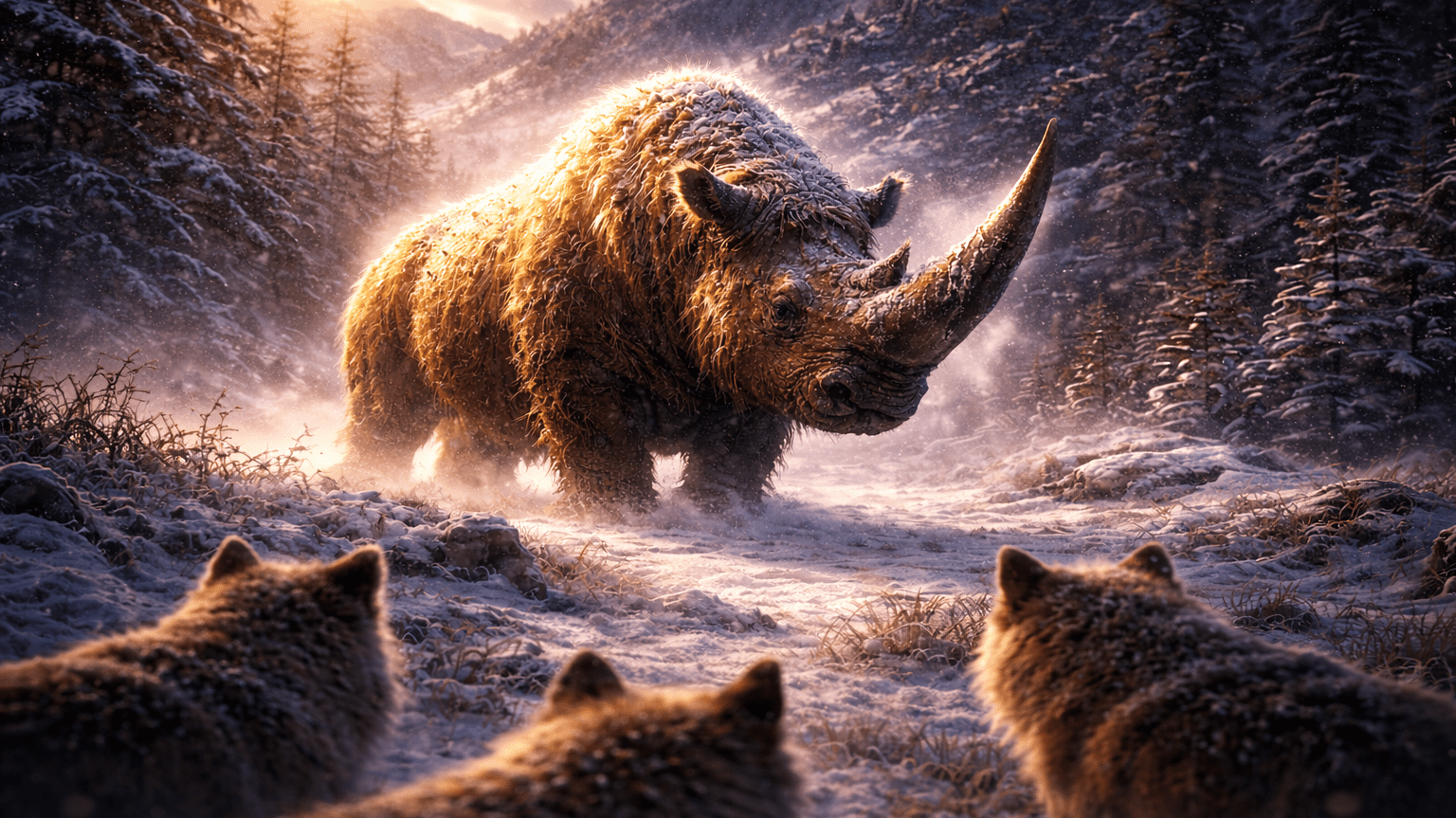
Deep within the Siberian permafrost, a story of the final days of the Ice Age lay frozen and silent for over fourteen thousand years. It was not a tale etched in stone or bone, but one held in the stomach of a mummified wolf pup. This tiny predator, perfectly preserved in the ice, carried a secret that would challenge a long held story about the disappearance of one of the era’s most iconic giants. When scientists began to study the pup, they made an astonishing discovery. Inside its stomach was a piece of undigested tissue, a final meal that had been locked in time. This was not just any tissue; it belonged to a woolly rhinoceros. This small fragment of flesh, miraculously preserved, offered an unprecedented opportunity to read the genetic story of one of the last woolly rhinos to walk the Earth, providing a direct window into the very end of its species.
For a very long time, the narrative of the woolly rhino’s extinction seemed clear and familiar. We imagined our early human ancestors as the ultimate hunters, tracking these colossal beasts across the frozen steppe. In this version of the past, skilled bands of hunters, armed with spears and relentless determination, gradually drove the rhino population to the brink. The evidence seemed to support this, as the timeline of human expansion often coincided with the decline of large megafauna. It was a simple, powerful story of human impact, one that has been told about many of the great creatures of the Pleistocene. But was it the complete truth? The information contained within that single piece of rhino muscle was about to introduce a profound contradiction, suggesting the story we had been telling ourselves might be wrong.
The real breakthrough came when scientists were able to sequence the entire DNA genome from the 14,400 year old rhino tissue. This genetic blueprint was then compared with the genomes of two older rhinos, one that lived 18,000 years ago and another from 49,000 years ago. The research team was searching for specific genetic markers that would indicate a species in trouble. Typically, a population that is dwindling over a long period shows signs of inbreeding and a loss of genetic diversity. As numbers fall, related individuals are more likely to breed, leaving a distinct and unhealthy signature in their DNA. But when the scientists analyzed the genome of the final rhino, they found no such evidence. Its genetic diversity was just as robust and healthy as its ancestors from tens of thousands of years earlier. This was not the genetic profile of a species slowly declining under pressure. It suggested the population was stable and healthy right up until the very end. The extinction, therefore, must have been caused by something else, something swift and catastrophic.
This new evidence points decisively towards a different culprit, a force far more powerful than human hunters. The true cause of the woolly rhino’s demise appears to be abrupt and severe climate change. The timeline of the rhino’s disappearance aligns perfectly with a period of intense global warming known as the Bølling Allerød interstadial, which began around 14,700 years ago. During this phase, the Earth’s climate shifted dramatically and rapidly. The vast, cold, and dry grasslands that these giant herbivores relied upon for food likely vanished in a very short amount of time, replaced by new forests and wetlands. The woolly rhinos, which were magnificently adapted for a frozen world, were suddenly faced with an environment where their food source had disappeared. Unable to adapt to the new warmer climate and the resulting changes in vegetation, their healthy and once thriving population crashed suddenly. Their extinction was not a slow burn, but a sudden and final event driven by a changing world.
Beyond rewriting the history of a single species, this remarkable find opens an exciting new frontier in paleontological research. The successful recovery of a high quality, complete genome from the stomach contents of a predator is a revolutionary achievement. It proves that valuable genetic information can be preserved in the most unexpected of places. This technique could unlock countless other secrets from the permafrost. The last meals of other frozen predators, such as cave lions or ancient bears, might hold the DNA of mammoths, extinct horses, or other Ice Age creatures, giving us a clearer picture of their lives and the world they inhabited. The story of the woolly rhino, as told by a wolf pup’s last meal, is a powerful lesson from the past. It reminds us that even the mightiest of creatures, perfectly adapted to their world, are incredibly vulnerable to rapid changes in the global climate. According to the research first reported by Live Science, which detailed the findings from a study in the journal Genome Biology and Evolution, our understanding of this extinction has now been fundamentally transformed. It is a humbling thought that the key to solving this ancient mystery was not found in a massive fossil, but in a tiny, undigested meal that waited patiently for thousands of years to tell its tale.