
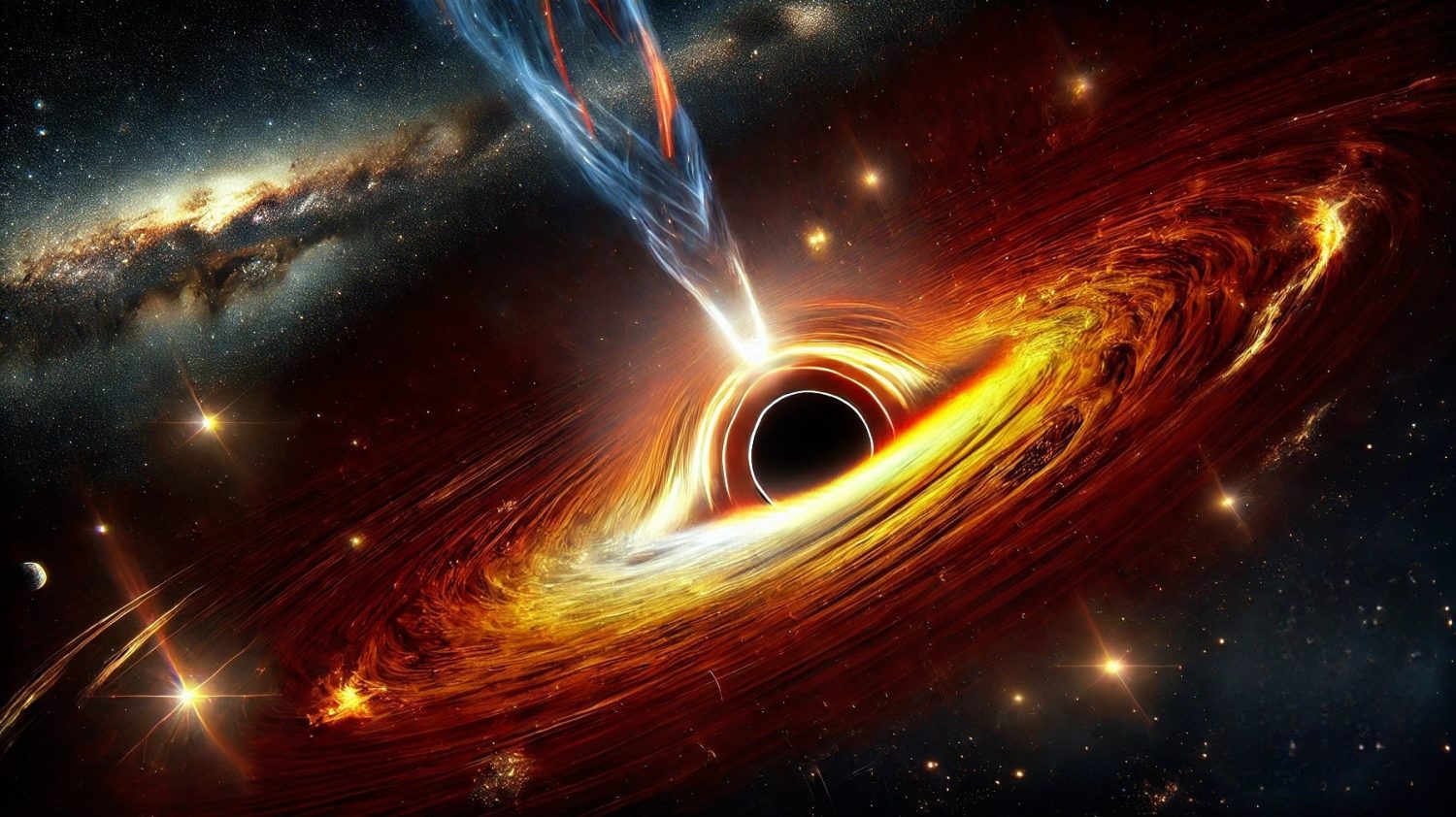
Black holes, among the most enigmatic entities in the universe, are not only known for their ability to consume everything in their path—including light—but also for their profound impact on time itself. According to Einstein’s theory of general relativity, time slows down near a black hole due to an effect known as gravitational time dilation. This strange phenomenon challenges our very perception of time, revealing a universe where time is not absolute but relative, influenced by massive gravitational forces. But what exactly causes this effect, and what would it mean for an object or person approaching a black hole?
To understand why time slows near a black hole, we must first grasp the concept of spacetime—a four-dimensional fabric where space and time are intertwined. Einstein’s revolutionary theory of general relativity, formulated in 1915, replaced Newton’s concept of gravity as a pulling force with the idea that massive objects bend the fabric of spacetime itself. The stronger the gravitational pull, the more spacetime curves, creating what we perceive as gravity. Black holes, being the most extreme manifestations of gravity, warp spacetime so intensely that they drastically alter the flow of time.
This phenomenon, known as gravitational time dilation, means that time runs slower in stronger gravitational fields. For someone far from a black hole, time flows normally, but for someone near its immense gravitational field, time would slow significantly. If an observer watched a spaceship approaching a black hole from a safe distance, they would see the clock aboard the spaceship ticking more and more slowly as it neared the event horizon—the point beyond which nothing can return. From the perspective of the distant observer, the spaceship would appear to freeze in time at the event horizon, never fully crossing it. However, for those on board the spaceship, time would feel normal, and they would experience the journey as usual—until they inevitably reached the singularity at the black hole’s center.
This bizarre effect is not just theoretical. Scientists have measured time dilation on a much smaller scale using satellites orbiting Earth. Because Earth’s gravity is weaker than that of a black hole, the time dilation effect is tiny but still measurable. In fact, GPS satellites must account for this effect to maintain precise timekeeping, as clocks in weaker gravity (higher altitudes) tick slightly faster than those on Earth’s surface.
The idea of extreme time dilation was famously depicted in the 2014 sci-fi film Interstellar, in which astronauts visit a planet orbiting a supermassive black hole named Gargantua. Due to the immense gravity, time on this planet is drastically slower—one hour on its surface equals seven years for those farther away. While the movie took some creative liberties, the core physics behind this concept is accurate. If a person were to orbit close enough to a black hole and return to Earth, they would experience a form of time travel into the future, as far more time would have passed for those on Earth than for them.
But what causes gravity to affect time in the first place? This question is best answered by Einstein’s equivalence principle, which states that acceleration and gravity are indistinguishable from each other. In other words, just as an astronaut moving near the speed of light experiences time dilation (as predicted by special relativity), the immense gravitational pull of a black hole has a similar effect. Essentially, gravity stretches the very fabric of time itself.
The closer one gets to a black hole’s singularity—the infinitely dense point at its core—the more extreme the time dilation becomes. In theory, time would slow infinitely as one nears the singularity, meaning that, from an external viewpoint, an object would never actually reach it. However, in the object’s own experience, time would continue normally until it was torn apart by the immense tidal forces in a process called spaghettification.
The implications of this phenomenon extend beyond black holes. It suggests that time is not universal but fluid, shaped by gravitational fields and motion. The study of gravitational time dilation not only helps us understand black holes better but also deepens our grasp of fundamental physics. As we continue exploring the cosmos, black holes may serve as natural laboratories for testing the most extreme conditions in the universe, perhaps even unlocking deeper mysteries about the nature of space and time itself.