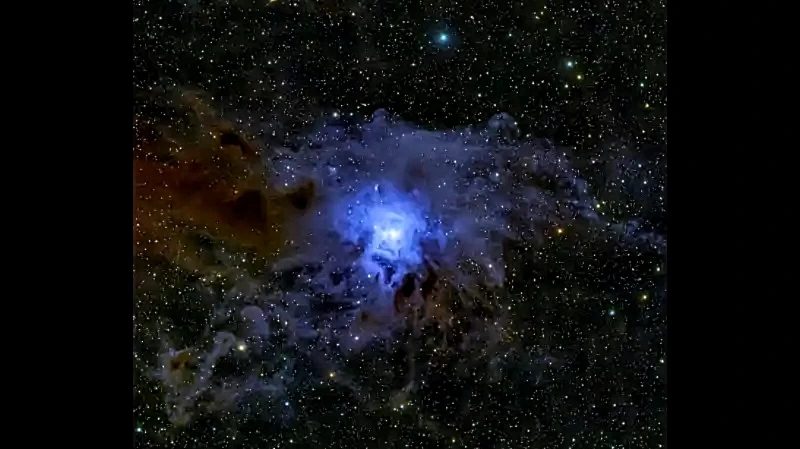
For decades, dark matter has remained one of the greatest enigmas in astrophysics, influencing the structure of galaxies while eluding direct detection. A groundbreaking study published in Physical Review Letters now suggests that an unexpected ionization pattern observed in the Central Molecular Zone (CMZ) of the Milky Way may hint at a previously unknown form of dark matter—one that is much lighter than the widely accepted Weakly Interacting Massive Particles (WIMPs). If confirmed, this discovery could fundamentally reshape our understanding of the universe’s invisible mass and force a reevaluation of long-standing dark matter models.
The CMZ, located at the heart of the Milky Way, is a region densely packed with hydrogen gas clouds, and for years, astronomers have detected an unusual ionization signature within it. Traditionally, such ionization has been attributed to cosmic rays—high-energy particles accelerated by extreme astrophysical events like supernovae and black hole activity. However, the latest analysis suggests that cosmic rays alone cannot account for the observed ionization levels, pointing instead to an unknown energy source. This discrepancy has led researchers to propose that sub-GeV dark matter, a class of particles significantly lighter than WIMPs, may be responsible.
Unlike WIMPs, which have dominated dark matter theories for decades, these light dark matter particles may annihilate each other upon interaction, producing electron-positron pairs. This annihilation process would release enough energy to ionize hydrogen gas, providing a compelling explanation for the observed ionization excess in the CMZ. The study argues that this mechanism represents one of the strongest indirect signals of dark matter interactions ever detected, potentially offering the first real observational evidence of dark matter beyond gravitational effects.
Adding to the intrigue, this hypothesis may also provide an answer to another long-standing cosmic mystery—the 511-keV gamma-ray emission line detected at the Milky Way’s center. For decades, astronomers have debated the origin of this gamma-ray signal, which suggests an excess of positrons (the antimatter counterparts of electrons). If light dark matter annihilation is occurring in the CMZ, it could be producing both the unusual hydrogen ionization patterns and the 511-keV gamma-ray signal, offering a unified explanation that aligns with multiple astrophysical observations.
If validated, this theory would mark a major shift in the search for dark matter. WIMPs have long been considered the leading candidate for dark matter, but their absence in direct detection experiments has prompted increasing skepticism. The existence of sub-GeV dark matter would not only reshape dark matter research but also introduce new experimental approaches to detect it. Scientists may now need to focus on low-energy particle detectors, astrophysical observations, and space-based missions to gather further evidence of these elusive particles.
This discovery also underscores the critical importance of studying galactic centers, where extreme conditions may unveil hidden aspects of fundamental physics. The upcoming generation of telescopes, including the James Webb Space Telescope (JWST) and the Square Kilometer Array (SKA), will allow astronomers to probe the Milky Way’s core with unprecedented precision. These instruments could confirm whether sub-GeV dark matter is indeed influencing the ionization of hydrogen gas, potentially solving one of the most pressing mysteries in modern astrophysics.
The implications of this study extend beyond dark matter alone. If sub-GeV dark matter exists and interacts in ways previously unknown, it would reshape cosmological models, influence how we understand the formation of galaxies, and redefine the very nature of the universe’s missing mass. While further research and observational data are needed to confirm this hypothesis, the prospect of finally detecting dark matter through its astrophysical fingerprints brings us closer than ever to unraveling one of the greatest mysteries of the cosmos.