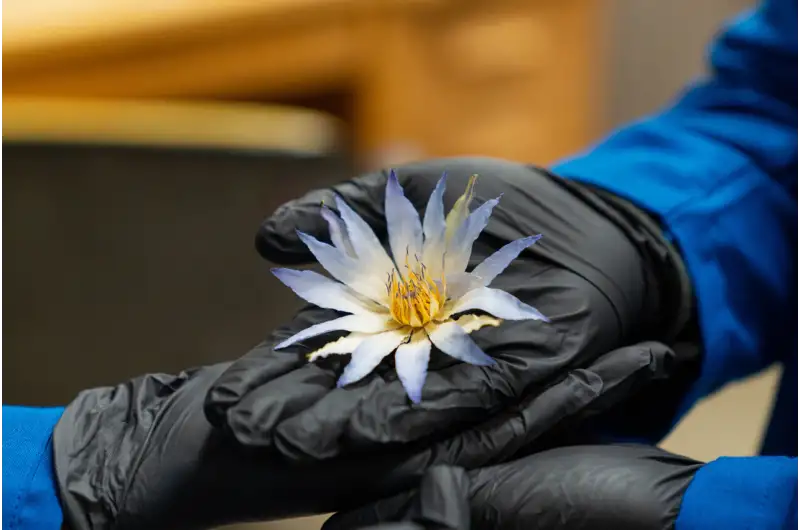
For centuries, the blue lotus (Nymphaea caerulea) has captivated historians, botanists, and spiritual seekers alike. Frequently depicted in the art and religious texts of ancient Egypt, this vibrant aquatic flower has long been associated with themes of rebirth, spiritual transcendence, and relaxation. Many believe that the blue lotus possessed psychoactive properties, potentially playing a role in Egyptian religious rituals and medicine. However, a groundbreaking study led by Liam McEvoy of UC Berkeley has revealed that much of what is sold today as “Egyptian blue lotus” is neither authentic nor as potent as historical accounts suggest. His research challenges modern assumptions, highlighting significant differences between the ancient plant and the versions commercially available today.
The blue lotus held a deep symbolic and cultural significance in ancient Egyptian civilization. Frequently appearing in tomb murals, temple carvings, and even burial sites, the flower was closely tied to cycles of life and death. Its petals, which open at sunrise and close at dusk, were thought to mirror the journey of the soul, making it a powerful emblem of rebirth in Egyptian mythology. Some scholars have proposed that it was used for more than just symbolic representation, speculating that the flower contained natural compounds capable of inducing mild psychoactive effects. This theory suggests that the blue lotus may have been an integral part of Egyptian religious ceremonies, dream rituals, and even medicinal practices.
To test these claims, McEvoy and a team of researchers at the UC Berkeley Center for the Science of Psychedelics analyzed authentic blue lotus samples preserved at the UC Botanical Garden. These were compared with modern samples purchased from online vendors. Their findings were startling. Many of the commercial products labeled as “Egyptian blue lotus” were, in fact, different species altogether, often lacking the key psychoactive compounds that researchers had expected to find. This discovery raises important questions about whether today’s so-called blue lotus products bear any resemblance to the plant revered by the ancients.
One of the most debated aspects of the blue lotus is its chemical composition. The plant is known to contain nuciferine, an alkaloid believed to have mild sedative and mood-enhancing properties. However, McEvoy’s study found that the concentration of this compound varied drastically between authentic ancient specimens and modern commercial samples. Some online products contained little to no nuciferine, suggesting that many consumers may not be experiencing the effects historically attributed to the plant. This discrepancy underscores how the commercialization of ancient botanical remedies often distorts their original significance and potential benefits.
Another key revelation from the study challenges the widely held belief that ancient Egyptians simply infused the blue lotus in wine to activate its psychoactive properties. While historical texts and artwork suggest that the flower was sometimes steeped in alcohol, McEvoy’s research indicates that an oil-based extraction method may have been the primary technique used to harness the plant’s active compounds. This alternative preparation could have allowed for more efficient absorption of its psychoactive elements, offering a new perspective on how Egyptians may have actually used the blue lotus in their spiritual and medicinal practices.
Despite these findings, modern marketing of the blue lotus continues to emphasize its supposed mystical effects, often exaggerating its role as a psychedelic or aphrodisiac. Today, the plant is sold worldwide as an herbal tea, essential oil, or smokeable substance, but McEvoy’s research warns that many of these products do not contain the true Nymphaea caerulea. This revelation raises ethical concerns about the accuracy of botanical labeling and the regulation of herbal supplements, as countless consumers may be unknowingly purchasing misidentified plants.
Looking ahead, McEvoy and his team plan to expand their research by employing advanced chemical analysis techniques, such as liquid chromatography, to further study the active compounds present in ancient blue lotus remains. They also hope to analyze Egyptian artifacts and burial residues for traces of lotus-infused oils or tinctures, which could provide direct evidence of how the plant was truly used thousands of years ago.
The story of the blue lotus serves as both a historical mystery and a cautionary tale. While it remains an enduring symbol of ancient Egyptian culture, modern interpretations have largely been shaped by speculation and commercial interests. McEvoy’s research is a reminder that scientific investigation is crucial in distinguishing myth from reality. Whether or not the ancient Egyptians truly experienced altered states through the blue lotus, one fact is clear: the modern world has yet to fully understand the secrets of this legendary flower.