
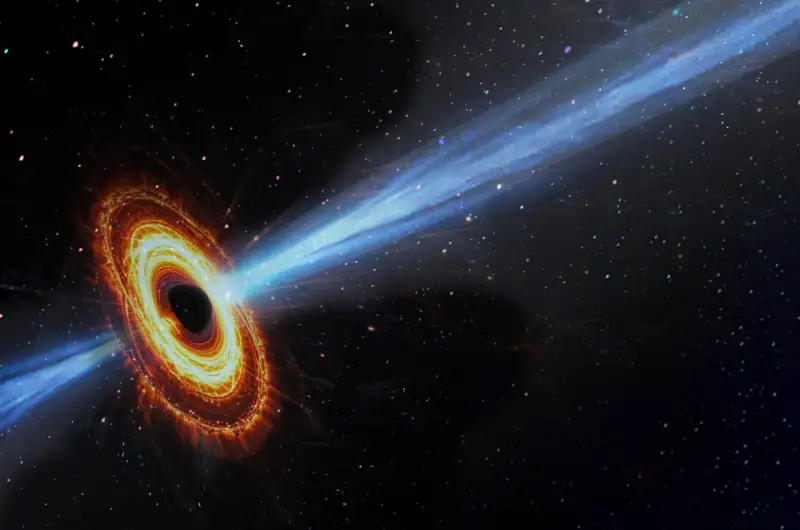
Black holes, often imagined as silent cosmic vacuum cleaners, are anything but passive. At the heart of some galaxies, supermassive black holes power immense jets of plasma that shoot out into space at nearly the speed of light. These jets, some stretching for millions of light-years, are among the most powerful and least understood structures in the universe. For years, astronomers have speculated about how these jets form and what keeps them going. Now, using the unparalleled capabilities of the Event Horizon Telescope (EHT), a global collaboration of scientists has captured a new and astonishing glimpse into these enigmatic structures.
Announced on March 24, 2025, in Astronomy & Astrophysics, the latest EHT observations show that these relativistic jets don’t just burst forth at full speed—they appear to accelerate as they move away from their black hole source. The finding challenges decades-old assumptions about jet physics and opens the door to new theories about the role of magnetic fields, plasma dynamics, and relativistic effects in the universe’s most extreme environments.
The Event Horizon Telescope is not a single telescope but an Earth-sized virtual observatory, created by synchronizing radio dishes on multiple continents—from Antarctica to Europe to Hawaii. Its resolution is so fine that it can capture images as sharp as those needed to resolve a donut-shaped silhouette of a black hole, like the famous image of M87* released in 2019. During the same 2017 campaign that captured that iconic black hole portrait, the EHT also focused on sixteen active galactic nuclei (AGN)—galaxies with supermassive black holes at their cores actively feeding on surrounding material and blasting out jets.
Until now, the prevailing theory held that these jets were ejected in conical shapes and moved at constant speed. But the EHT’s new findings tell a different story. By combining its data with those from the Very Long Baseline Array (VLBA) and the Global Millimeter VLBI Array (GMVA), astronomers tracked how the brightness temperature—a measurement related to the energy density of radio emission—changed with distance from the black holes. Contrary to expectations, they found that the brightness temperature increases as the jets travel outward. This rising intensity suggests that the jets are actually accelerating over vast distances.
The implication is profound. Instead of being launched at full throttle, these jets might be picking up speed due to powerful magnetic fields near the black hole or from geometrical effects related to the jets’ curvature and our viewing angle. One scenario is that particles in the jet are truly gaining speed as they move outward, energized by the black hole’s rotational energy and twisted magnetic field lines. Alternatively, the apparent acceleration could be an optical illusion, caused by the jet bending toward our line of sight and creating a beam-brightening effect.

While the current study cannot definitively separate these possibilities, it marks the first large-scale observational evidence that AGN jets evolve more dynamically than previously thought. In particular, it suggests that magnetization—a measure of how dominated the jet is by magnetic fields—might play a pivotal role not just in launching the jet but also in maintaining and accelerating it over time.
Magnetic fields are suspected to thread through the accretion disk—the swirling mass of gas and dust around the black hole—and into the jet, acting like giant cosmic springs. The EHT’s ability to observe at multiple frequencies allowed scientists to probe these inner regions, strengthening the case for magnetically driven acceleration.
This latest advance underscores the power of collaborative astrophysics. Only by pooling data from different telescope networks could the EHT team trace jet behavior from near the black hole out to light-years away, effectively mapping their evolution. And while this study used data collected in 2017, the EHT has continued to upgrade, with new instruments and higher-frequency observations (like the 345 GHz campaign in 2024) promising even sharper views of black hole environments.
The stakes are high. Understanding how these jets work isn’t just an exercise in celestial mechanics—it’s key to understanding how black holes influence galaxy formation, regulate star birth, and redistribute matter and energy across the universe. Supermassive black holes don’t just devour matter; they shape the very cosmos we inhabit, and their jets may be one of the primary tools they use to do it.
As more data rolls in from future EHT campaigns, researchers hope to confirm whether the acceleration is physical or apparent, and to investigate the structure of magnetic fields near the event horizon. These questions cut to the heart of how black holes operate—not just as destructive forces, but as engines driving the universe’s largest-scale dynamics.
In short, the EHT has once again peeled back a layer of mystery surrounding black holes. The very same telescope that gave humanity its first glimpse of a black hole’s shadow is now revealing how these cosmic giants might launch matter at phenomenal speeds—changing our understanding of the universe, one jet at a time.
