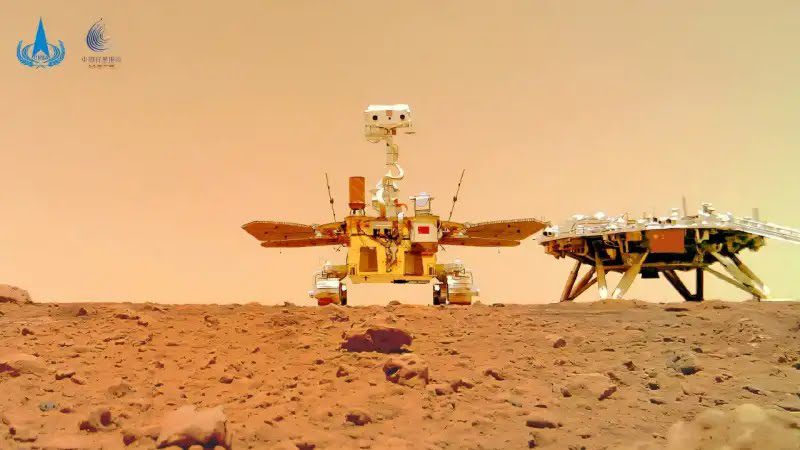
In a monumental stride for planetary science, China’s Zhurong rover has unveiled compelling evidence that Mars once harbored vast oceans, reshaping our understanding of the Red Planet’s climatic history and its potential to support life. This revelation stems from meticulous analyses of data collected by the rover, indicating that approximately 3.5 to 4 billion years ago, Mars boasted significant bodies of water, with coastal formations strikingly reminiscent of Earth’s own shorelines.
The Zhurong rover, a pivotal component of China’s Tianwen-1 mission, has been diligently exploring the Utopia Planitia region since its successful landing in May 2021. Equipped with advanced ground-penetrating radar, Zhurong possesses the unique capability to peer beneath the Martian surface, allowing scientists to investigate its subsurface structures with unprecedented clarity. Recent analyses of this radar data have unveiled thick, stratified sedimentary layers extending up to 35 meters deep, bearing a striking resemblance to coastal deposits found on Earth. These formations are indicative of ancient sandy beaches, sculpted by sustained wave actions, and bolster the hypothesis that Mars once possessed substantial bodies of liquid water.
The implications of this discovery are profound. The existence of such extensive water bodies suggests that early Mars had a significantly warmer and wetter climate, potentially creating conditions conducive to life. The presence of ancient oceans would have played a crucial role in shaping the planet’s climate and geological features, influencing atmospheric composition and potentially fostering habitable environments. This new evidence challenges previous assumptions about Mars’ arid history and opens exciting avenues for astrobiological research.
The identification of these ancient shorelines was made possible through the collaborative efforts of an international team of planetary scientists, led by Hai Liu from Guangzhou University. Their research meticulously details the analysis of Zhurong’s radar data. The team considered various geological processes that could have led to the observed subsurface structures, such as aeolian (wind-driven) activity or fluvial (river-related) formations. However, the characteristics of the sedimentary layers—specifically their thickness, continuity, and stratification—strongly support the interpretation of coastal deposition resulting from ancient oceanic wave actions.
This discovery not only enhances our understanding of Mars’ geological past but also has significant implications for future exploration missions. Identifying regions that once contained large bodies of water is crucial for selecting landing sites in the search for past Martian life. Sedimentary deposits, especially those formed in aquatic environments, are prime targets for astrobiological studies because they have a high potential for preserving biosignatures. The Utopia Planitia basin, with its newly discovered ancient shorelines, emerges as a promising candidate for such investigations.
Moreover, understanding Mars’ hydrological history aids in comparative planetology studies, offering insights into the climatic evolution of terrestrial planets, including Earth. By examining the factors that led to Mars’ transition from a wet, warm environment to its current cold, arid state, scientists can better comprehend the delicate balance of conditions necessary for sustaining life. This knowledge is invaluable, not only for understanding our own planet’s past and future but also for assessing the habitability of exoplanets in distant star systems.
The success of the Zhurong rover underscores the importance of international collaboration in space exploration. Combining technological advancements with shared scientific expertise accelerates the pace of discovery and enriches our collective knowledge of the cosmos. As missions like Tianwen-1 continue to yield groundbreaking data, the global scientific community moves closer to unraveling the mysteries of Mars and the broader universe.
In conclusion, the detection of ancient Martian shorelines by China’s Zhurong rover marks a significant milestone in planetary science. This discovery not only reshapes our understanding of Mars’ climatic and geological history but also invigorates the quest to uncover evidence of past life on the Red Planet. As we continue to explore and study these extraterrestrial landscapes, each finding brings us one step closer to answering the profound question of whether life ever existed beyond Earth.
China’s Mars Rover Just Found Proof of Ancient Oceans, Was Life There Too?