Imagine walking into an apothecary in 16th-century Europe, complaining of a headache, epilepsy, or a nasty bruise. The remedy? A pinch of finely ground human mummy, mixed into wine or sprinkled onto wounds. This wasn’t a fringe practice or the concoction of quacks—it was mainstream medicine, endorsed by physicians and swallowed by royals. Known as “mumia,” this powdered substance derived from preserved human corpses was consumed across Europe for centuries. For almost 700 years, the dead were dosed as medicine, until science, skepticism, and a better understanding of translation and ethics finally brought the practice to an end.
The story begins not with ghoulish intent, but with a linguistic and cultural error that took on a life of its own. In the medieval Islamic world, the term mūmiyā referred to bitumen—a natural tar prized for its medicinal properties. Arab physicians like Avicenna used it to treat wounds and internal ailments, documenting its benefits in Arabic medical texts that would later be translated into Latin. But somewhere in the process of translation and transmission, European scholars misread the term. Instead of interpreting mūmiyā as a black resin, they associated it with Egyptian mummies—embalmed human bodies often covered in pitch or tar-like substances. That misunderstanding set the stage for one of the strangest medical crazes in Western history.
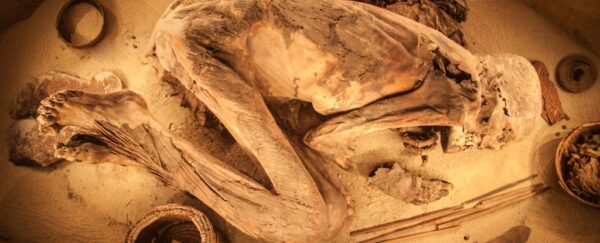
By the 12th century, European apothecaries had begun importing real Egyptian mummies to grind into powder. And by the Renaissance, the trade in “genuine” mumia was booming. Physicians believed that these preserved remains held curative powers. Following the now-discredited “doctrine of signatures,” which suggested that the characteristics of a substance revealed its healing potential, many thought that the lifelike appearance of mummies meant they still carried vital energy—a force that could be transferred to the living. According to a March 2025 article from ScienceAlert, this belief was further supported by the prevailing theory of vitalism, which held that life was driven by a mysterious vital force that could be absorbed through remedies like mumia.
Europe’s fascination with mumia was not limited to the elite. Everyone—from commoners to kings—believed in its curative magic. Mumia was prescribed for everything from nosebleeds to plague. It was sold by weight in shops, blended into tinctures, rubbed onto wounds, and infused into drinks. And as demand soared, so did the need for supply. Tomb raiders scoured Egypt, stealing bodies to meet Europe’s appetite. Some merchants turned to local sources—dried corpses from executed criminals or unclaimed bodies—often passing them off as ancient imports. While some shipments may have included true ancient mummies, much of what was sold as mumia was fake, or at least freshly sourced. Nevertheless, the myth held.

What kept mumia on the shelves for so long? In a world with little access to effective treatments, where disease was rampant and medicine was often guesswork, people clung to whatever hope they could find. Religious and ethical objections were rare. Consuming the dead for healing was considered distinct from cannibalism—because it was medicinal, it was tolerated, even encouraged. The Catholic Church, which governed much of Europe’s moral life at the time, did not object. And with no better alternatives, mumia seemed to work—especially when belief played such a central role in healing.
Not everyone was convinced, though. By the 16th century, reformist thinkers and early scientists began challenging mumia’s efficacy. Among them was the Swiss physician Paracelsus, who dismissed it as superstitious nonsense. He argued that real medicine should come from nature, not corpses. His dissent marked the beginning of mumia’s slow decline, but the practice remained surprisingly resilient. Even as empirical science began to take root in the 17th and 18th centuries, some physicians continued to prescribe it. Apothecaries still kept jars of the stuff on hand, and old habits proved hard to break.
What ultimately ended mumia’s reign wasn’t just better medicine—it was a cultural shift. As Egyptology emerged in the 18th century, the mummies that had once been commodified for their supposed healing power were reimagined as cultural treasures. Tombs that had been raided for pharmaceuticals became archaeological sites of immense historical value. The bodies were no longer viewed as magical relics but as sacred artifacts of a long-lost civilization. Combined with the rise of ethical concerns and the growing authority of evidence-based science, this new perspective sealed mumia’s fate.
By the 19th century, mumia had mostly disappeared from European pharmacies, relegated to history’s dustbin alongside leeching, humoral theory, and other relics of pre-modern medicine. Yet the story of mumia lives on, not just as a curiosity but as a cautionary tale. As ScienceAlert notes, it’s a striking reminder that the boundary between science and superstition is often thinner than we’d like to believe. A single mistranslation sparked centuries of grave robbing and corpse consumption—because it aligned with what people wanted to believe about health, vitality, and the mysteries of the human body.
Even today, echoes of mumia persist in the wellness industry and fringe medicine. The hunger for miracle cures—especially those with exotic, ancient, or natural origins—has not gone away. We may laugh at the idea of drinking powdered mummy, but the same desire for transformation through consumption still shapes health culture in subtle ways.
Mumia’s history is more than a footnote in weird medicine—it’s a mirror reflecting the powerful blend of belief, desperation, and misinformation that can shape entire civilizations. In the end, it took science, respect for the dead, and a growing awareness of cultural heritage to close the chapter. But for centuries, in the heart of Europe’s most trusted apothecaries, the dead walked again—not as ghosts, but as ground-up medicine.