Our brains are extraordinary biological machines made up of billions of specialized cells, all working together to make us who we are. They allow us to think, move, feel, remember, and perceive the world around us. But how exactly does this complex system work? And how is all that information organized inside such a tiny, jelly-like structure?
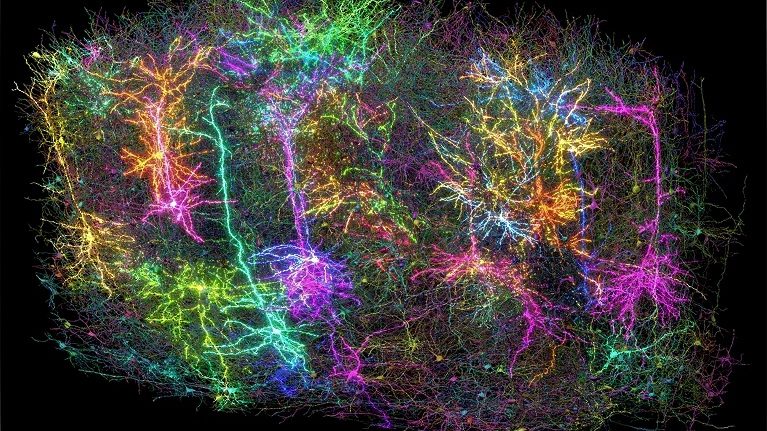
In a landmark achievement, scientists have taken an unprecedented leap in understanding the brain’s inner workings by creating the most detailed 3D map of a mammalian brain ever produced. The project, led by over 150 researchers as part of the US MICrONS initiative, focused on just one cubic millimeter of brain tissue, roughly the size of a grain of sand, from a mouse’s visual cortex. Despite its tiny size, this sliver of brain revealed a universe of complexity.
Let’s break this down simply. Our brains are made of brain cells called neurons, which send and receive messages. Imagine neurons as tiny messengers, constantly firing signals to communicate with one another. Each neuron connects to many others via synapses, which are like miniature bridges or junctions. When one neuron wants to pass along a message, it sends an electrical signal down a thin extension called an axon, which connects to the next neuron through a synapse. A chemical messenger then crosses the synapse to deliver the signal. This is how thoughts, memories, emotions, and movements are formed.
In the MICrONS project, researchers reconstructed this micro-section of mouse brain and mapped over 200000 brain cells, including around 82000 individual neurons and more than 500 million synapses. The total length of wiring, meaning the axons and dendrites stretching between neurons, measured over 4 kilometers, all packed into a cube just a millimeter wide. Even more remarkable, this map doesn’t just show the physical layout of the brain. It also includes information about how these neurons were firing when the mouse was seeing specific images, including scenes from the movie The Matrix.
How did they do this? First, researchers recorded the brain activity of a living mouse while it watched different visual inputs. Then, after ethically ending the experiment, they preserved a slice of the mouse’s brain. That tiny cube of tissue was then cut into thousands of sections, each thinner than a human hair. Using electron microscopy, imaging with beams of electrons instead of light, they captured high-resolution images of every slice. These were digitally stitched together into a 3D model. But even with the images, making sense of the data was a monumental task. This is where artificial intelligence and machine learning came in. The researchers used AI to analyze and label each neuron, axon, and synapse, identifying patterns and connections no human could map manually.
This effort is part of a growing field known as connectomics, which aims to chart the wiring diagram of the brain, how every neuron connects to others and what those connections do. It’s a bit like going from knowing what parts a computer has to understanding how every circuit is wired, what it powers, and how it reacts when you press a button.
So why does this matter? Because understanding these connections could help us answer some of the most profound questions in science and medicine. How are memories stored? How does learning happen? What goes wrong in conditions like Alzheimer’s, epilepsy, or depression? With maps like this, scientists can start to decode not just what the brain is, but how it works, and even begin to mimic it in artificial intelligence systems.
While this study was done in a mouse brain, it lays the foundation for future efforts in human brain mapping. It also highlights just how vast and complex even a tiny sliver of brain matter really is. Each neuron is not just a switch, it is part of an incredibly dense, dynamic network that shapes every moment of our awareness.
As one of the project’s leaders described it, this is the neuroscience equivalent of going from early hand-drawn maps to Google Earth. And for the first time, we’re starting to see the living circuitry of thought itself.