Last month, ISRO successfully launched Chandrayaan 3, which is expected to reach the moon in 40 days. However, if we were to go to Mars instead of the moon, it could take anywhere from 7 months to 4 years using the most advanced rockets available today. This long and costly journey becomes even more critical if the mission is crewed. In space travel, time behaves like fuel, as the longer you stay in space and travel, the more resources you consume. If we aspire to explore the other planets in our solar system, we need to think beyond conventional rocket engines. To address this challenge, researchers are tirelessly working to enhance efficiency and speed.
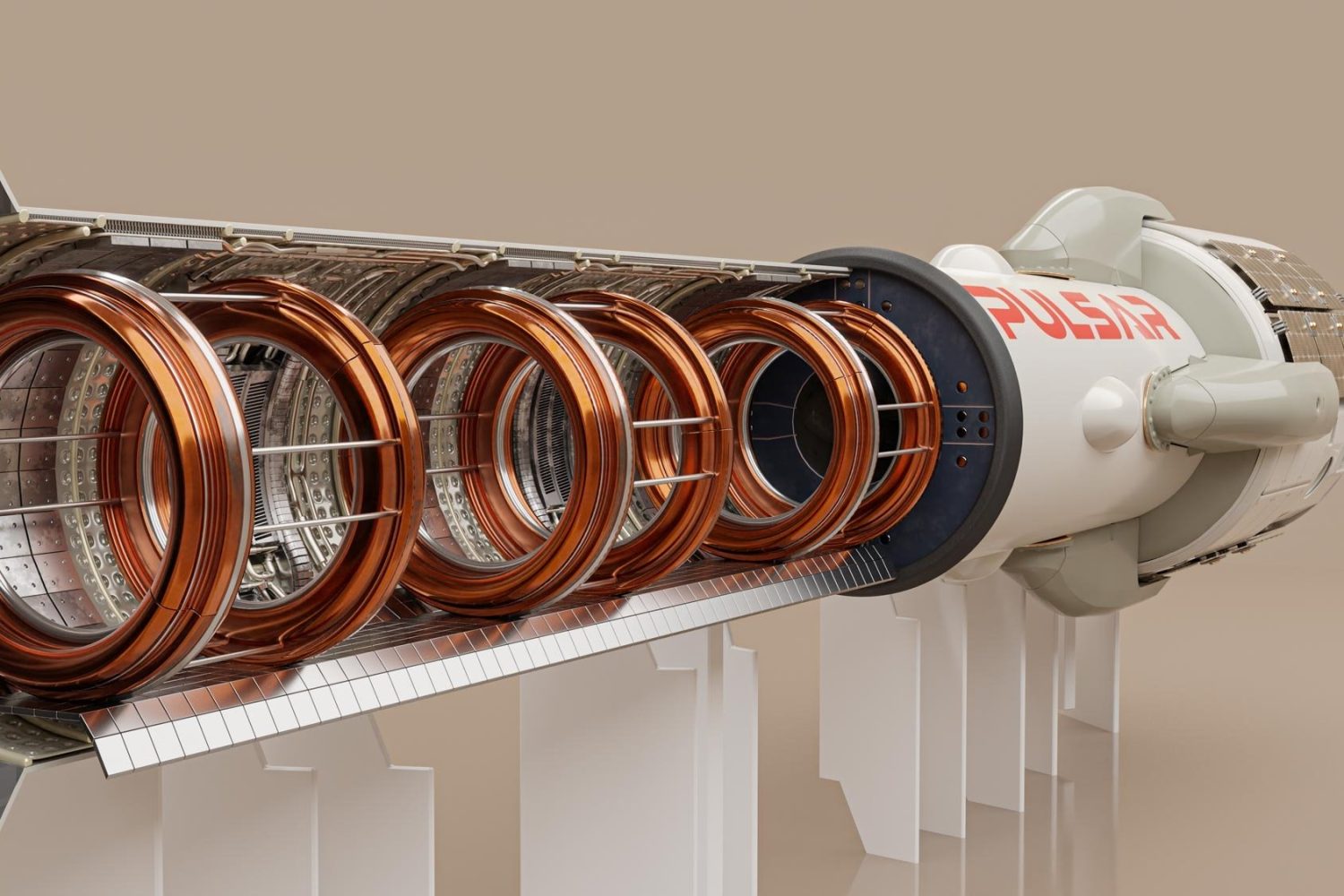
Pulsar Fusion, a UK-based company, creating a rocket engine that could change the game – the world’s largest Nuclear Fusion Rocket Engine. With an estimated speed of 800,000 kilometers per hour, it is set to revolutionize interplanetary travel and potentially cover the distance from Earth to Mars in just one to two weeks by 2027.
What is Nuclear Fusion?

Before we proceed, let’s understand what Nuclear Fusion actually means. Alright, you must already be familiar with atoms – the basic building blocks of everything in the universe. Nuclear Fusion is the process by which two light atomic nuclei combine to form a single heavier atom while releasing massive amounts of energy.
These fusion reactions take place in a state of matter called plasma — a hot, charged gas made of positive ions and free-moving electrons with unique properties distinct from solids, liquids, or gases. The sun, along with all other stars, is powered by this reaction. To fuse in our sun, nuclei need to collide with each other at extremely high temperatures, around ten million degrees Celsius. The high temperature provides them with enough energy to overcome their mutual electrical repulsion.
Once the nuclei come within a very close range of each other, the attractive nuclear force between them will outweigh the electrical repulsion and allow them to fuse. For this to happen, the nuclei must be confined within a small space to increase the chances of collision. In the sun, the extreme pressure produced by its immense gravity creates the conditions for fusion.
Nuclear Fusion Rocket Engine:

Okay, now let’s delve into the extraordinary application of the power of nuclear fusion in rocket engines. As mentioned earlier, plasma plays a central role in nuclear fusion rocket engines. Plasma is an exceptional state of matter, a scorching hot, electrically charged gas composed of positively charged ions and free-moving electrons. What sets it apart from solids, liquids, or gases are its unique properties and behaviors.

Taming the super-hot plasma within the engine’s electromagnetic field is an immense challenge. Plasma behaves like a complex and unpredictable weather system, making it highly elusive to manage and stabilize. The particles within the plasma move with incredible energy, leading to chaotic and dynamic movements, which demand sophisticated technologies and precision control mechanisms.

To tackle this formidable challenge head-on, Pulsar Fusion, has partnered with Princeton Satellite Systems in the US. Together, they harness cutting-edge supercomputer algorithms to meticulously analyze and forecast the behavior of plasma. Leveraging the remarkable computational capabilities of supercomputers, they simulate and model various plasma scenarios, providing crucial insights to researchers.
Direct Fusion Drive (DFD) – Efficiency and Potential:
At the heart of Pulsar Fusion’s project lies the Direct Fusion Drive (DFD), a type of engine where charged particles from nuclear fusion reactions are used directly to create thrust, bypassing the need for energy conversion into electricity. This makes DFD a more efficient propulsion option compared to traditional methods. Additionally, DFD is powered by atomic isotopes, eliminating the need for a massive fuel payload, which is a game-changer for long-duration space missions.
The Path to Success:
Pulsar Fusion’s ambitious project is set to witness the firing of the 8-meter-long fusion rocket engine in 2027. If successful, the chamber will achieve temperatures of several hundred million degrees, surpassing the Sun’s heat. Such a breakthrough could pave the way for rocket speeds of 500,000 miles per hour, revolutionizing space travel.
Beyond Space Travel: Clean, Limitless Energy for Earth

The impact of nuclear fusion propulsion extends beyond interplanetary travel. Successfully harnessing nuclear fusion holds the potential to provide clean, virtually limitless energy for Earth. Unlike traditional nuclear fission reactors, which produce harmful radioactive waste, nuclear fusion reactors would generate minimal waste and rely on abundant fuel sources, such as hydrogen isotopes found in seawater. This could be a game-changer for our planet’s energy needs, offering a sustainable and clean solution to address climate change and energy demands.
Conclusion:
The development of the world’s largest nuclear fusion rocket engine by Pulsar Fusion is a significant step towards realizing the immense potential of nuclear fusion propulsion. While challenges remain, the fusion rocket engine represents a crucial leap forward in space exploration, promising faster interplanetary travel and the exploration of distant worlds. Moreover, successful fusion reactions could unlock the door to clean, limitless energy for humanity, revolutionizing how we power our world. As scientists and engineers continue to push the boundaries of this groundbreaking technology, the fusion of space travel and clean energy production becomes an ever more promising and inevitable future for humanity.