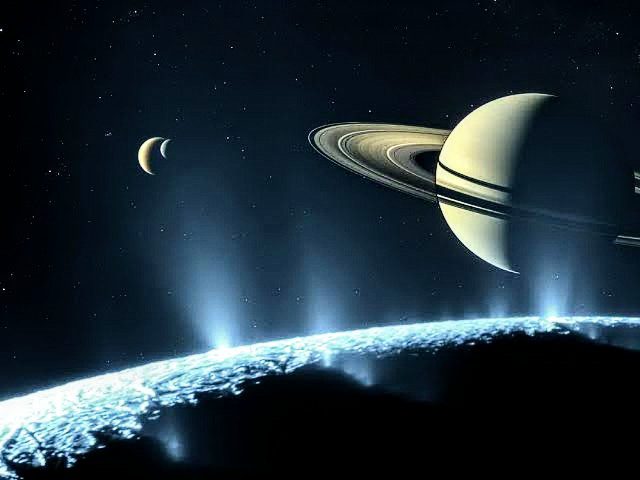
Saturn has once again claimed the title of the planet with the most moons, following the discovery of 128 previously unknown natural satellites. This monumental finding brings Saturn’s total moon count to 274, significantly surpassing Jupiter’s 95 moons and reaffirming its status as the “moon king” of the solar system. The discovery, confirmed by the International Astronomical Union (IAU), was made using advanced observational techniques that allowed astronomers to detect these tiny, elusive celestial bodies orbiting the gas giant.
The newly identified moons are small, irregularly shaped objects, likely fragments from larger celestial bodies that were captured by Saturn’s immense gravitational pull. Many of these moons are thought to be remnants of ancient collisions, possibly originating from a single catastrophic event that shattered a larger moon within the last 100 million years. Their irregular and elongated orbits suggest that they did not form alongside Saturn but were instead gravitationally ensnared from surrounding space, adding new layers to our understanding of the chaotic and violent history of the early solar system.
The discovery was made using data collected from the Canada-France-Hawaii Telescope between 2019 and 2021, with further analysis conducted in 2023. Astronomers employed a technique known as “shift and stack,” which enhances the visibility of faint celestial objects against the backdrop of space. This method allowed them to track the slow, distant movements of these moons over time, confirming their orbits and validating them as true Saturnian satellites.

Unlike Saturn’s well-known moons, such as Titan and Enceladus, which are large and possess unique atmospheric or geological features, these newly discovered moons are much smaller, averaging just a few kilometers in diameter. Their unusual orbits and irregular shapes indicate that they were once part of larger parent bodies that were shattered by high-speed impacts. The presence of so many fragmented moons suggests that Saturn’s gravitational influence has played a significant role in shaping and reshaping its surrounding environment over billions of years.
Beyond simply adding to Saturn’s impressive moon count, this discovery has far-reaching implications for our understanding of planetary systems. These irregular moons serve as time capsules, preserving evidence of ancient collisions and interactions that have influenced Saturn’s evolution. Studying them can help astronomers reconstruct the planet’s dynamic past, shedding light on how celestial bodies form, break apart, and reassemble under the influence of gravity.
The newfound moons also raise intriguing questions about whether even more remain undiscovered. With the continued advancement of telescope technology and refined data analysis techniques, astronomers anticipate that further discoveries could push Saturn’s moon count even higher. The findings highlight the ongoing mysteries of the outer solar system, demonstrating that even well-explored planets like Saturn still have secrets waiting to be uncovered.
As researchers continue to study these moons, they hope to learn more about their origins, compositions, and potential interactions with Saturn’s rings. These tiny celestial bodies, often overlooked in favor of their larger counterparts, may hold key insights into the processes that govern planetary formation and evolution. With each new discovery, our understanding of the solar system deepens, reminding us that the cosmos is far more dynamic and complex than we once imagined.