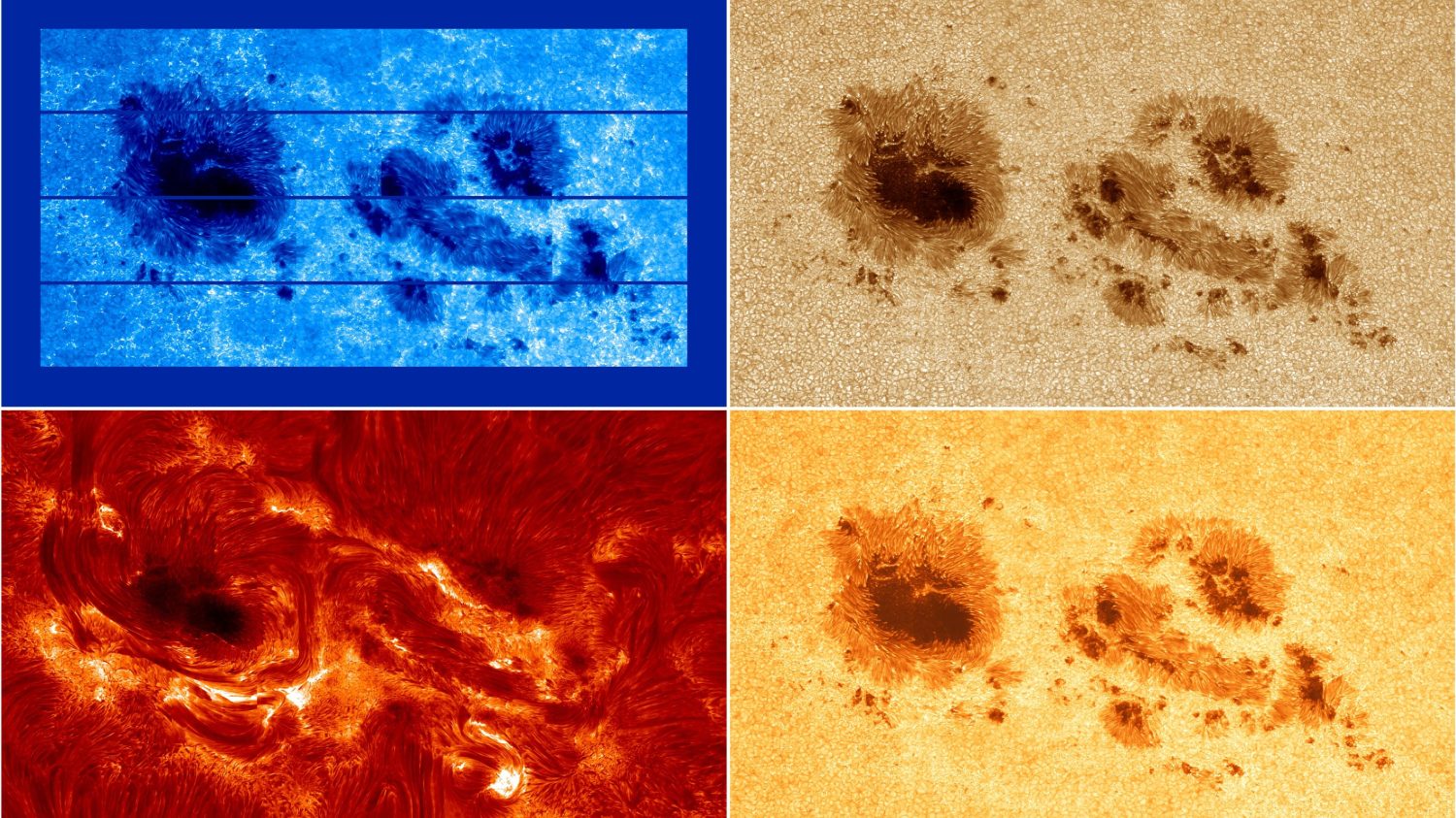
This is the closest humanity has ever come to witnessing the Sun’s spectacular fury at the moment of eruption, a moment of immense, raw power that shapes the fate of worlds. A single breath of our star, captured in unprecedented high resolution, revealed the twisted magnetic structures responsible for some of the most violent explosions in the solar system, providing critical data for safeguarding our terrestrial technology. The event centered on an active sunspot region, a temporary dark blemish on the Sun’s photosphere, which acted as the crucible for two immense X class solar flares in late 2025. These phenomenal energetic bursts were meticulously documented by an international team of researchers utilizing the powerful GREGOR solar telescope, situated high in the clear atmosphere of the Canary Islands. GREGOR’s ability to pierce through atmospheric distortion provided a vision of the Sun’s surface and atmosphere that was previously unattainable, offering views sharp enough to track magnetic features the size of small continents. Understanding these flares is far more than an academic exercise; it is an urgent necessity for safeguarding our modern, technologically dependent civilization. These powerful stellar explosions launch streams of charged particles and intense radiation directly toward Earth, events that can ignite breathtaking auroras, but also pose a significant threat to our satellite networks, global positioning systems, and vulnerable power grids.
To truly appreciate what was captured, we must peer into the physics of a sunspot. These regions are cooler than the surrounding solar material because gigantic loops of the Sun’s magnetic field lines—like colossal, invisible rubber bands—become so concentrated that they inhibit the normal flow of heat rising from the interior. As the Sun rotates, the foot points of these magnetic loops drag and tangle, coiling tighter and tighter within the superheated plasma. Imagine twisting two ends of a massive rope, woven from pure energy, until the internal stress becomes unbearable. The critical moment arrives when the lines snap. This violent reconfiguration of the magnetic field releases energy equivalent to billions of megatons of TNT in mere minutes, accelerating particles to near light speed and sending a shockwave across interplanetary space. But what happens immediately after that colossal magnetic field disconnects, and how does the energy transform from pure potential stress into a planet altering storm? This is the core mystery GREGOR was designed to solve, and the images provided a chilling, detailed roadmap of the chaotic energy conversion.
The high resolution observations showed the intricate dance of bright, ultra hot plasma filaments just before the two massive flares detonated. Scientists observed miniature, localized explosions—precursors they call—where magnetic energy was already leaking out, subtly signaling the impending cataclysm. It was like watching the cracking and groaning of a dam moments before it completely burst. The flares themselves were visible as incredibly bright ribbons of light tracing the paths of the newly reconnected magnetic field lines, revealing for the first time in such detail how the energy streams downwards, heating the lower atmosphere, and simultaneously blasts outwards into space, creating a coronal mass ejection. This process, the sudden, cataclysmic unburdening of magnetic stress, is what generates the potentially damaging solar storms that threaten Earth.
The immediate consequence of such a large X class flare is often a coronal mass ejection—a vast bubble of magnetized plasma containing billions of tons of solar material hurtling away from the Sun at millions of miles per hour. When this cloud collides with Earth’s magnetic shield days later, the resulting geomagnetic storm can induce powerful electrical currents in long conductors on the ground, famously leading to transformer failures and communication disruptions. The detailed views from GREGOR allowed researchers to better model the speed and trajectory of these expelled coronal mass ejections, refining space weather prediction capabilities which are crucial for protecting global infrastructure. Prior to these images, scientists relied on lower resolution data that often blurred the fine structures essential for modeling the physics of the explosion’s initiation. Now, we have a clear, crisp view of the ignition sequence, moving us closer than ever to predicting not just if a flare will happen, but how powerful and how fast its resulting storm will travel toward us.
This revolutionary data provides the first true high definition insight into the heart of a solar dynamo, validating decades of theoretical modeling by showing the specific mechanisms—the shear and entanglement of the field lines—that lead to these most powerful solar events. By mapping the magnetic geometry with such precision, future missions and ground based observatories can focus their instruments on the most volatile regions with greater confidence. These captured moments of magnetic mayhem underline the incredible volatility of our star and the delicate balance of protection provided by our planet’s own magnetosphere. They are not merely pretty pictures of fire; they are critical blueprints for planetary defense, teaching us to respect and anticipate the celestial forces that constantly wash over our small, blue haven. Ultimately, as we gaze upon the Sun’s fiery, explosive complexity, we are reminded that we live perpetually within the radiant, beautiful, yet perilous shadow of a star.