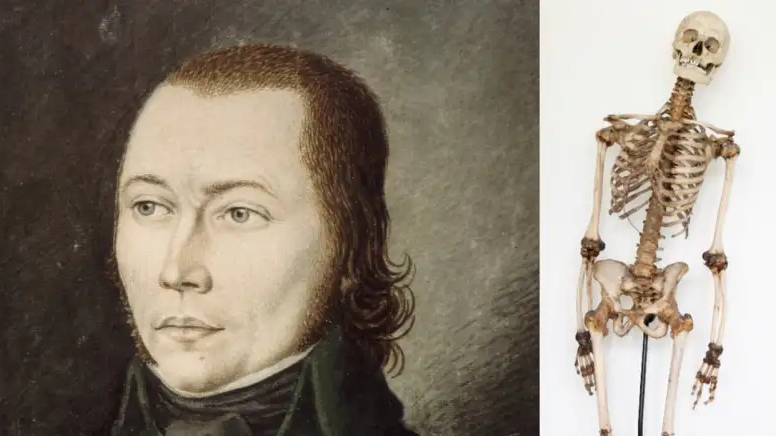
For more than 220 years, the skeletal remains of Germany’s legendary outlaw Johannes Bückler—known widely as Schinderhannes—lay mislabeled in Heidelberg University’s Anatomical Collection. Executed in 1803 by guillotine in Mainz alongside his accomplice Christian Reinhard, also called Schwarzer Jonas, both men’s remains were delivered to the university in 1805 for anatomical study. Somewhere along the way, their skeletons were mistakenly switched, sparking a historical mystery that persisted for generations. But now, thanks to cutting-edge forensic science and international collaboration, researchers have finally set the record straight—identifying the real skeleton of Schinderhannes and correcting one of Germany’s oldest anatomical mix-ups.
The breakthrough was made possible by a team of scientists led by Dr. Sara Doll from Heidelberg University and Professor Walther Parson from the Medical University of Innsbruck. Their findings, published in March 2025 and reported by Phys.org, detail how a combination of anthropological analysis, radiological imaging, isotope testing, and advanced DNA sequencing was used to re-examine the two skeletons. Their goal: determine once and for all which bones belonged to the famous Rhineland robber who inspired ballads, books, and plays.
One of the most critical techniques used was mitochondrial DNA analysis, which traces maternal lineage and is often extracted from ancient remains due to its resilience. Researchers compared genetic material from the skeletons with that of a living maternal descendant of Schinderhannes. Nuclear DNA helped further confirm the identity. Additionally, isotope analysis of the teeth and bones provided information about the diet and geographical background of the individual—evidence that pointed to the Hunsrück region, where Schinderhannes grew up and operated. All data converged to reveal that the skeleton long believed to be Schwarzer Jonas was, in fact, Schinderhannes himself.
But this wasn’t just a case of correcting a label. The DNA work also offered a rare opportunity to reconstruct Schinderhannes’ physical features. Genetic traits indicated he had brown eyes, dark hair, and fair skin—bringing a degree of visual clarity to a man whose appearance has often been obscured by romanticized or inconsistent historical accounts. In essence, the research humanized the legend, transforming him from myth into man.

Yet one question still remains: what became of Schwarzer Jonas? With his skeleton mistakenly labeled as Schinderhannes’ for over two centuries, the true whereabouts of Reinhard’s remains are now unknown. It’s possible they were misplaced, destroyed, or misfiled elsewhere. While the mystery surrounding Jonas continues, the successful identification of Schinderhannes offers hope that, one day, his accomplice’s story may also be fully pieced together.
Beyond the personal identities of two historic figures, this case underscores the immense power of modern forensic science. By applying 21st-century technology to 19th-century remains, scientists demonstrated how DNA, isotopes, and imaging can illuminate the past in ways unimaginable even a few decades ago. It’s a powerful reminder that history isn’t static—it’s a puzzle that can be refined and redefined with every new tool we develop.
For historians, folklorists, and enthusiasts of Germany’s rebellious anti-heroes, this discovery is a milestone. Johannes Bückler, once a figure of legend, now rests with his true name restored—a poetic end to a story that began in violence and misidentification but concluded with truth and scientific triumph. As researchers continue to explore the university’s archives and skeletal collections, there may be more secrets to uncover—proof that sometimes, history just needs the right evidence to speak again.