A groundbreaking discovery at South Africa’s Swartkrans Cave has shed new light on the physical diversity and survival challenges of Paranthropus robustus, an early human relative that lived around 2 million years ago. The fossilized remains of an exceptionally small adult, designated SWT1/HR-2, have stunned paleoanthropologists, as this individual stood just 1.03 meters tall—making it smaller than the famous Australopithecus afarensis specimen “Lucy” and even the diminutive Homo floresiensis, known as the “hobbit” species of Indonesia. This rare find raises profound questions about the variability within P. robustus, the role of environmental pressures on its evolution, and the survival challenges it faced in a predator-dominated landscape.
Swartkrans Cave, located in the Cradle of Humankind, is one of the richest fossil sites in the world, providing a deep well of insight into early hominin evolution. Paranthropus robustus, a species distinguished by its powerful jaw and large teeth adapted for tough plant-based diets, has long been considered a key part of the hominin family tree. However, the discovery of such a small individual disrupts previous assumptions about the species’ typical body size. Theories explaining this unexpected variation range from natural genetic diversity to environmental stressors such as malnutrition, suggesting that early hominin populations may have been more physically diverse than previously thought. It is also possible that this individual belonged to a distinct population of smaller-bodied P. robustus, a hypothesis that could challenge long-held views on the uniformity of this species.
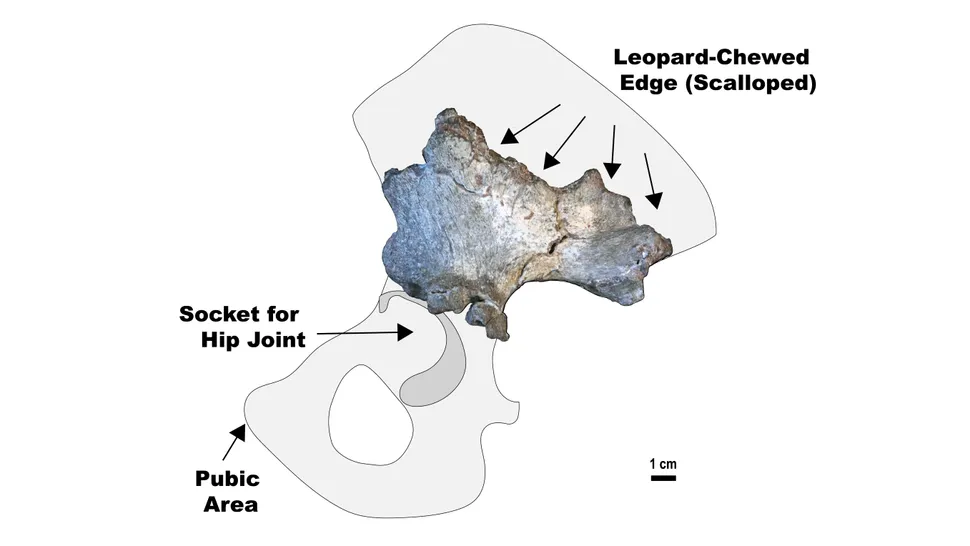
Beyond its stature, what makes this fossil particularly remarkable is the preservation of three critical leg bones—the hip, femur, and tibia—offering rare insight into P. robustus locomotion. Analysis confirms that SWT1/HR-2 was fully bipedal, walking upright like modern humans, yet its skeletal structure also hints at arboreal adaptations. This suggests that while P. robustus primarily moved on the ground, it likely retained the ability to climb trees, an invaluable survival trait in a dangerous prehistoric environment. The combination of terrestrial and arboreal mobility would have allowed it to access food in multiple habitats while avoiding predators—a factor that proved crucial in an ecosystem teeming with large carnivores.
However, despite these survival adaptations, SWT1/HR-2 appears to have met a violent end. Distinct puncture marks on the bones match the bite pattern of a leopard, suggesting that this individual fell victim to one of the region’s dominant predators. This aligns with previous evidence from Swartkrans, where multiple hominin fossils have been found with similar marks, reinforcing the idea that early humans and their relatives were not only hunters but also prey. This constant predation pressure may have influenced behavioral adaptations, possibly driving hominins to seek shelter in caves or adopt complex social behaviors for defense.
The significance of this discovery extends far beyond a single fossil. Well-preserved P. robustus remains are exceptionally rare, and each new specimen provides crucial data on the physical and behavioral diversity of early hominins. The small stature of SWT1/HR-2 raises new questions about how variable P. robustus populations were and whether different ecological pressures influenced their evolutionary trajectory. If future excavations uncover more individuals of similar size, it could indicate a previously unrecognized population or even a case of evolutionary dwarfism in response to environmental constraints.
Ongoing research at Swartkrans aims to uncover additional remains that could further clarify the role of body size variation in P. robustus evolution. A more complete skeleton could reveal whether this small individual was an exception or representative of a broader population trend. Additionally, studies into predator-prey dynamics in early hominin habitats will help scientists understand how survival challenges shaped human evolution.
This remarkable discovery offers a glimpse into the often brutal realities of life in the prehistoric world, where even our closest relatives were vulnerable to the forces of nature. As paleoanthropologists continue their search for more clues, fossils like SWT1/HR-2 remind us that the story of human evolution is far from complete. Each new find brings us closer to understanding the diverse paths our ancestors took in their journey toward becoming modern humans.