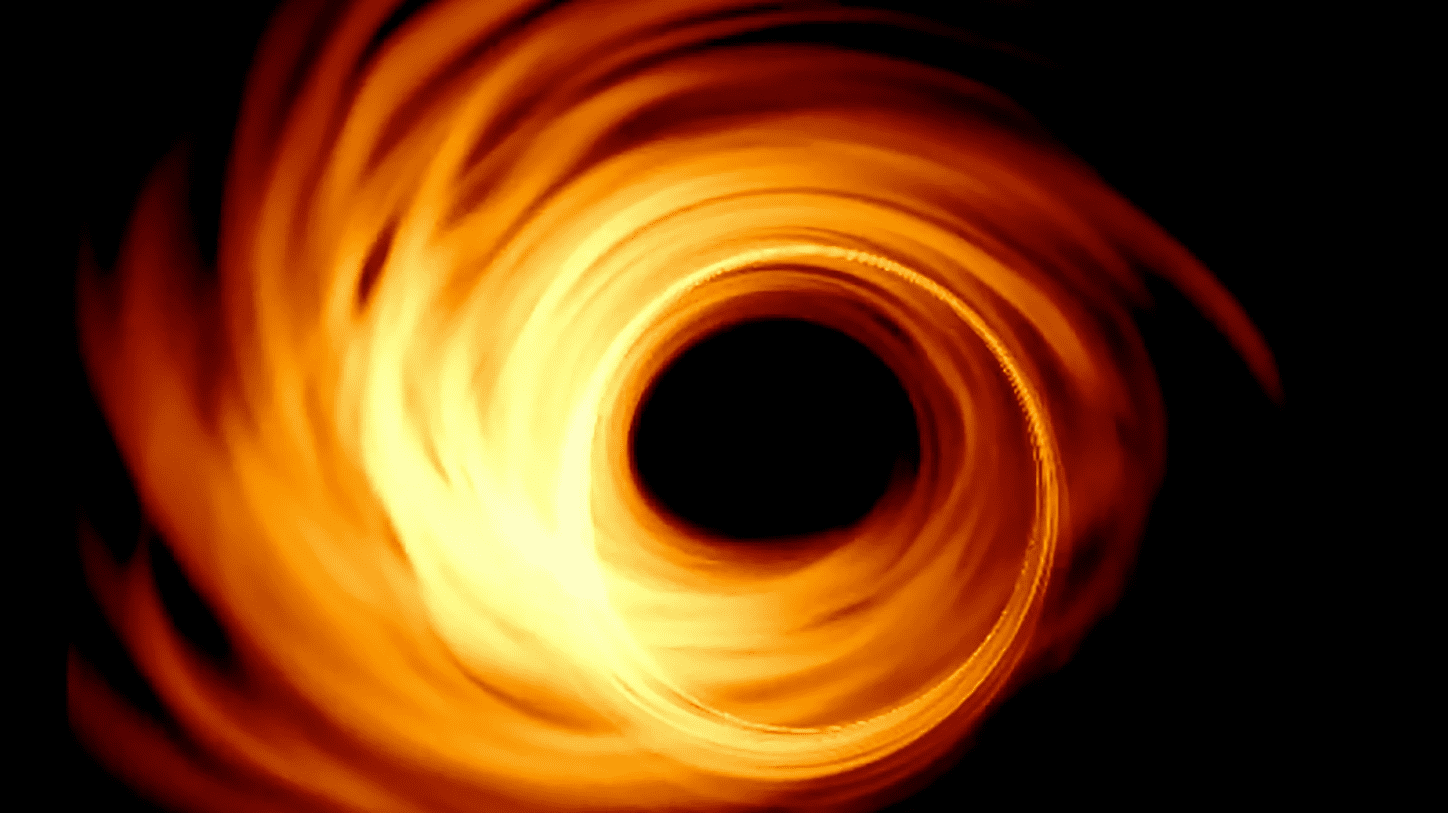
Black holes, the enigmatic titans of space, have long captivated the imagination of scientists and laypeople alike. These cosmic phenomena are regions of spacetime exhibiting gravitational acceleration so intense that nothing—no particles or even electromagnetic radiation such as light—can escape from its gravitational pull.
What is a Black Hole?
A black hole is a region of spacetime exhibiting gravitational effects so powerful that nothing can escape its event horizon. It is formed from the remnants of a massive star that has depleted its nuclear fuel and ended its lifecycle. When such a star with a mass greater than the Tolman–Oppenheimer–Volkoff limit (around 2-3 solar masses) undergoes catastrophic gravitational collapse, the core implodes under its own gravity. If the remnant’s mass exceeds the Tolman–Oppenheimer–Volkoff limit (around 2-3 solar masses), it cannot be supported by electron degeneracy pressure and will inevitably collapse into a black hole. However, if the remnant’s mass falls below a critical value known as the Chandrasekhar limit (about 1.4 solar masses), it can become a stable white dwarf held up by the degeneracy pressure of electrons.
The Singularity: Heart of the Black Hole
At the center of a black hole lies the singularity, an infinitely dense point where matter is crushed to infinite density and space-time curvature becomes infinite. Here, the gravitational field strength approaches mathematical infinity, causing our current understanding of physics to break down. The singularity represents the limitations of classical physics and general relativity, indicating the need for a quantum theory of gravity to fully describe the conditions within.
Why Even Light Can’t Escape
The reason light cannot escape a black hole is fundamentally tied to the extreme curvature of spacetime itself. Einstein’s theory of general relativity predicts that a sufficiently compact mass can deform spacetime to form a black hole. The boundary of this warped region is known as the event horizon. Inside this horizon, the escape velocity required to overcome the gravitational pull exceeds the speed of light, making it impossible for any form of matter or radiation to break free.
The Fate of Falling into a Black Hole
If one were to hypothetically fall into a black hole, they would experience a phenomenon known as spaghettification. This violent effect arises due to the extreme differential gravitational forces within the black hole, which would vertically stretch and compress any object into long thin strips by the intense tidal forces. Before reaching the singularity, the intense high-energy radiation from the accretion disk surrounding the black hole would likely vaporize any falling object.
Inevitable Conclusion: Death by Black Hole
The journey into a black hole is an irreversible one-way trip from which there is no possibility of return or escape. The immense gravitational pull combined with the extreme environmental conditions near the event horizon ensure that nothing physical survives the plunge intact. Once past the event horizon, not only is escape kinematically impossible due to exceeding lightspeed, but the standard physical laws as we understand them no longer apply. The intense gravitational field ensures the complete and inevitable destruction of any form of known matter or energy that crosses this cosmic point of no return.
While the mysterious nature of black holes may inspire creative speculation, there is no empirical evidence that falling into a black hole would transport someone to a “fifth dimension” or alternate universe. Our current scientific understanding indicates that anything passing the event horizon is simply destroyed by the extreme tidal forces and gravitational singularity at the core.
In conclusion, black holes represent not just fascinating astronomical objects but also serve as natural cosmic laboratories for probing the limits of our current physical theories and understanding the most extreme conditions in the universe. While their mysterious nature may inspire speculation about other dimensions or universes, the empirical reality is that they are relentless gravitational sinkholes from which there is no escape for any form of known matter or energy.