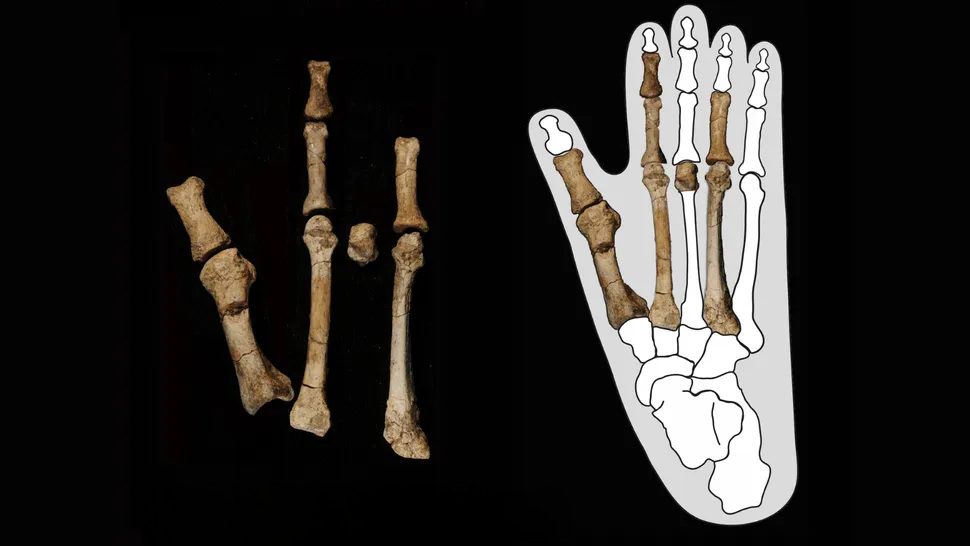
Lucy, the world’s most famous ancient relative, did not walk the ancient earth alone; she had a secret cousin whose footprints tell a radically different story of human origins. For decades, the iconic Australopithecus afarensis, whose remains epitomize our early steps toward upright walking, represented the sole branch of the human family tree flourishing in the Afar region of Ethiopia some 3.4 million years ago, but a silent fossil discovered in that very landscape has now ripped that singular narrative wide open, confirming a bustling, diverse evolutionary neighborhood where multiple hominin species shared the same African savanna. This groundbreaking realization stems from a strange, partially preserved foot fossil dating back three and a half million years, a remnant so distinct that scientists have confidently assigned it to a species already named but previously known from only scant jaw fragments: Australopithecus deyiremeda. The discovery is profoundly significant because it places two distinct, closely related human ancestors side by side in the same geographical space at the same moment in deep time, forever complicating the beautifully simple line we once drew from apes to humans.
The location of this remarkable find, the Woranso Mille area of Ethiopia, is exactly the same sprawling, dusty cradle that gave us Lucy, yet the anatomy locked within this single foot bone speaks of an entirely separate evolutionary pathway. When paleoanthropologists first laid eyes on the fossil, they were immediately struck by its divergence from Lucy’s species, particularly the structure of the ankle and the toe bones, which betray subtle yet fundamental differences in how this individual moved across the ancient terrain. To understand why this fragment of bone is causing such a seismic shift in our understanding, we must momentarily pause and consider the foundational science of our own two feet. Our feet are essentially rigid levers, sprung arches designed for long distance walking and efficient transfer of force, a direct specialization for obligate bipedalism, the hallmark of the human lineage. Lucy’s feet, while not perfectly modern, show a clear transition toward this rigidity, indicating she spent most of her time on the ground, but the foot belonging to Australopithecus deyiremeda tells an older, more conflicted story, exhibiting traits that strongly suggest a significant part of its life was still spent climbing high in the safety of the trees.
This anatomical duality forces us to confront a profound evolutionary puzzle: how did these two physically distinct but closely related hominins manage to share resources and avoid extinction? The question of simultaneous existence immediately conjures images of ancient rivalry, a hidden evolutionary struggle for survival where two cousins, driven by the same needs for food and water, might have clashed on the edges of the savanna. Were they fierce competitors, locked in a brutal contest for dominance over the sparse watering holes and fruit bearing trees of the Miocene epoch? Could Lucy and her kin have regarded their mysterious cousins not as partners in progress, but as direct threats to their own burgeoning success? The very idea that our earliest human story involved parallel tracks and potential conflict adds a dramatic tension to the usually quiet world of deep time archaeology, forcing us to wait patiently for the rocks to reveal the details of their ancient interaction.
The resolution to this thrilling natural suspense lies in the very specialized differences in their skeletal structures, particularly the foot. While Lucy’s Australopithecus afarensis was becoming increasingly terrestrial, optimizing its stride for ground based locomotion, the Australopithecus deyiremeda individual evidenced by this new fossil retained crucial adaptations for an arboreal life, a powerful grip and flexibility necessary for scaling trees. This difference in mobility likely served as an elegant biological separation mechanism, allowing them to effectively divide the ancient environment into specialized niches. Lucy’s species could dominate the open ground, exploiting resources like roots and tubers far from the canopy, while A. deyiremeda could retreat into the forests, utilizing fruits and leaves accessible only by skilled climbers. This concept, known as niche partitioning, suggests that instead of fighting for the same exact dinner plate, these two species cleverly utilized different parts of the buffet, minimizing direct, damaging competition and allowing both to thrive side by side for hundreds of thousands of years.
The confirmation that Lucy was not the sole evolutionary experiment in East Africa transforms our concept of early human history from a narrow procession into a sprawling, bushy garden of life. Our origins were far messier, far more diverse, and infinitely more fascinating than previously imagined, proving that nature rarely commits to a single path when exploring the vast potential of life. This single, strange foot, perfectly preserved in the ancient sands, is not just a scientific datum; it is a whisper from a hidden past, reminding us that the story of humanity is not a monologue delivered by one heroic ancestor, but a rich, complex conversation between many cousins, all tentatively exploring what it meant to walk upright in the dawn of our species.