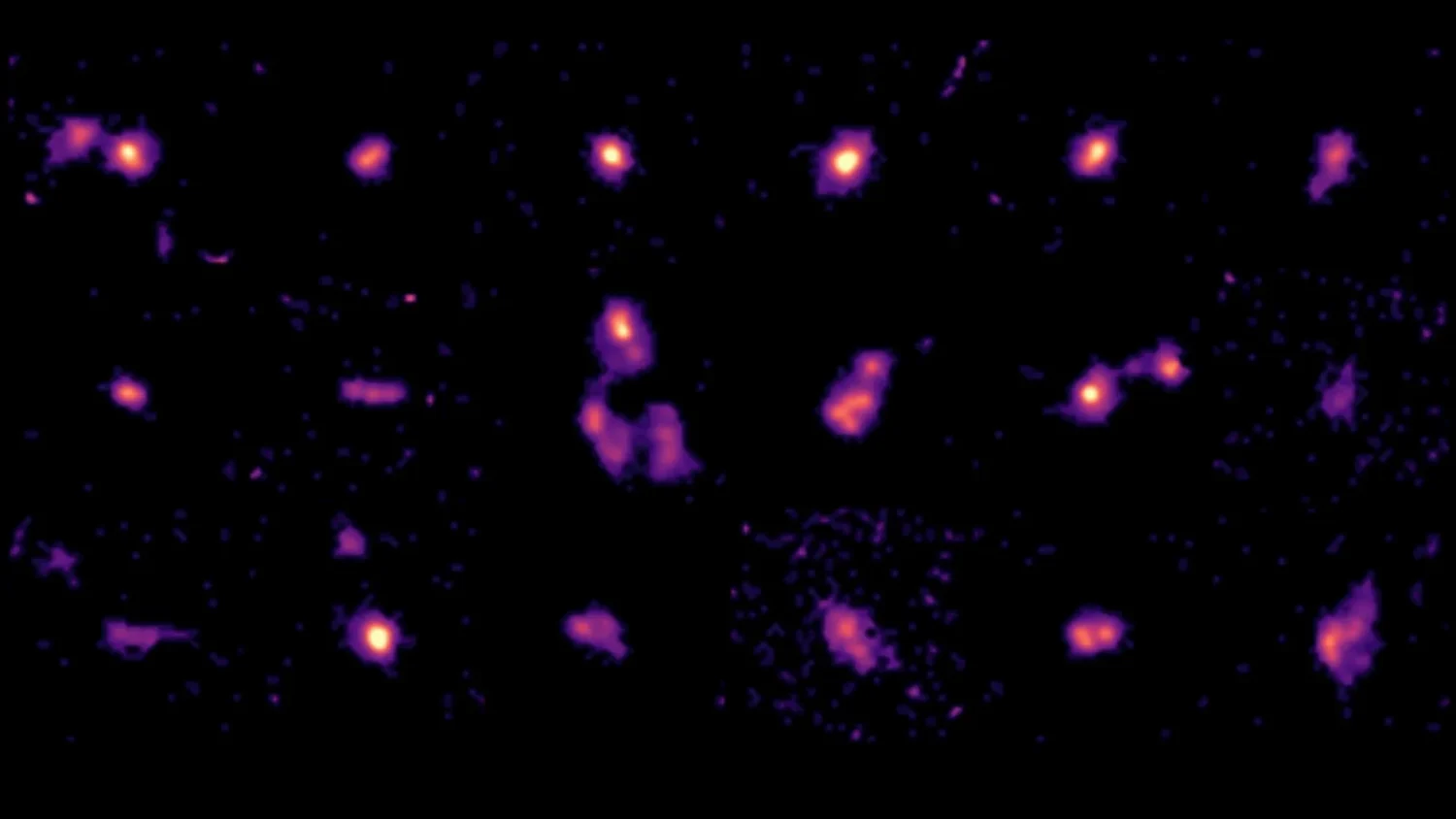
Looking deep into space is like looking back in time. The light from the most distant objects has traveled for billions of years to reach our telescopes, offering us a glimpse into the universe’s infancy. When astronomers peer across these immense cosmic distances, they expect to see the universe as it was, a nursery of simple, chaotic, and slowly developing structures. But a recent discovery has turned this expectation on its head. Imagine looking at a photograph of a two year old child and finding that they have the physical and behavioral traits of a teenager. This is precisely the cosmic puzzle that a team of scientists has uncovered, a finding that challenges our fundamental understanding of how quickly the universe grew up. Using the combined power of the James Webb Space Telescope, the Hubble Space Telescope, and the Atacama Large Millimeter/submillimeter Array, or ALMA, researchers embarked on an ambitious survey to study eighteen galaxies as they existed 12.5 billion years ago. This means they were observing these celestial islands just one billion years after the Big Bang, a mere blink of an eye in cosmic terms. What they found was not a collection of primitive, toddler galaxies.
Instead, they saw cosmic teenagers, galaxies that were astonishingly mature and complex for their age. One of the most startling discoveries was the sheer abundance of heavy elements within these young galaxies. In astronomy, any element heavier than hydrogen and helium is referred to as a metal. These metals, like the carbon and oxygen essential for life, are forged in the fiery hearts of massive stars and are only scattered into space when those stars die in spectacular supernova explosions. For a galaxy to be rich in these elements, it must have gone through many rapid cycles of star birth and death. The prevailing models of galaxy formation suggested this enrichment process should take billions of years, yet here it was, fully established in the universe’s first billion years. But how could these elements have been created and distributed so quickly?
The answer seems to lie in the sheer intensity of star formation, a period of violent and explosive starbursts that far exceeded what was thought possible. The presence of these metals was not the only sign of accelerated aging. The very structure of these galaxies was a major surprise. Many of them displayed organized, rotating stellar disks, much like the one that defines our own Milky Way galaxy. This stable, ordered structure was thought to be a hallmark of maturity, achieved after billions of years of chaotic mergers and gravitational settling. Finding such well behaved disks so early in cosmic history suggests that the path to galactic adulthood can be remarkably short. Adding to this picture of precocious development, astronomers found that these galaxies were also hosting supermassive black holes at their centers, which were actively and voraciously feeding on surrounding gas and dust. These central engines were growing at a furious pace, contributing to the overall sense that these were systems on a fast track to maturity. Perhaps the most perplexing piece of the puzzle was not just that the heavy elements existed, but where they were found. The telescopes revealed that elements like carbon were not confined to the star forming regions of the galactic disk. Instead, they were spread out in a remarkably uniform blanket extending more than 30,000 light years into the diffuse halo of gas surrounding the galaxies, an area known as the circumgalactic medium. This created what scientists call a flat metal gradient, meaning the concentration of metals was nearly the same everywhere. This observation defied all expectations, as it would seemingly take an immense amount of time and energy to transport and mix these elements so thoroughly over such vast distances. The solution to this mystery appears to be as dramatic as the discovery itself.
The intense, rapid-fire supernova explosions from the starbursts likely fueled powerful galactic winds. These cosmic hurricanes, stronger than any model had previously predicted, were powerful enough to blast the newly forged metals out of the galaxy and into the surrounding halo, mixing them evenly with the primordial gas. It was a violent and incredibly efficient process that seasoned the entire galactic ecosystem almost overnight. This groundbreaking view into the cosmic past comes from the ALPINE CRISTAL survey, led by Andreas Faisst of Caltech, with findings presented at the 247th meeting of the American Astronomical Society. It reveals a universe that was far from slow and predictable in its youth. Instead, it was a place of rapid, explosive change, where the first galaxies aged with an intensity that we are only now beginning to comprehend. We see that the universe did not wait long to build the complex structures we know today, forging its own path in the dark.