
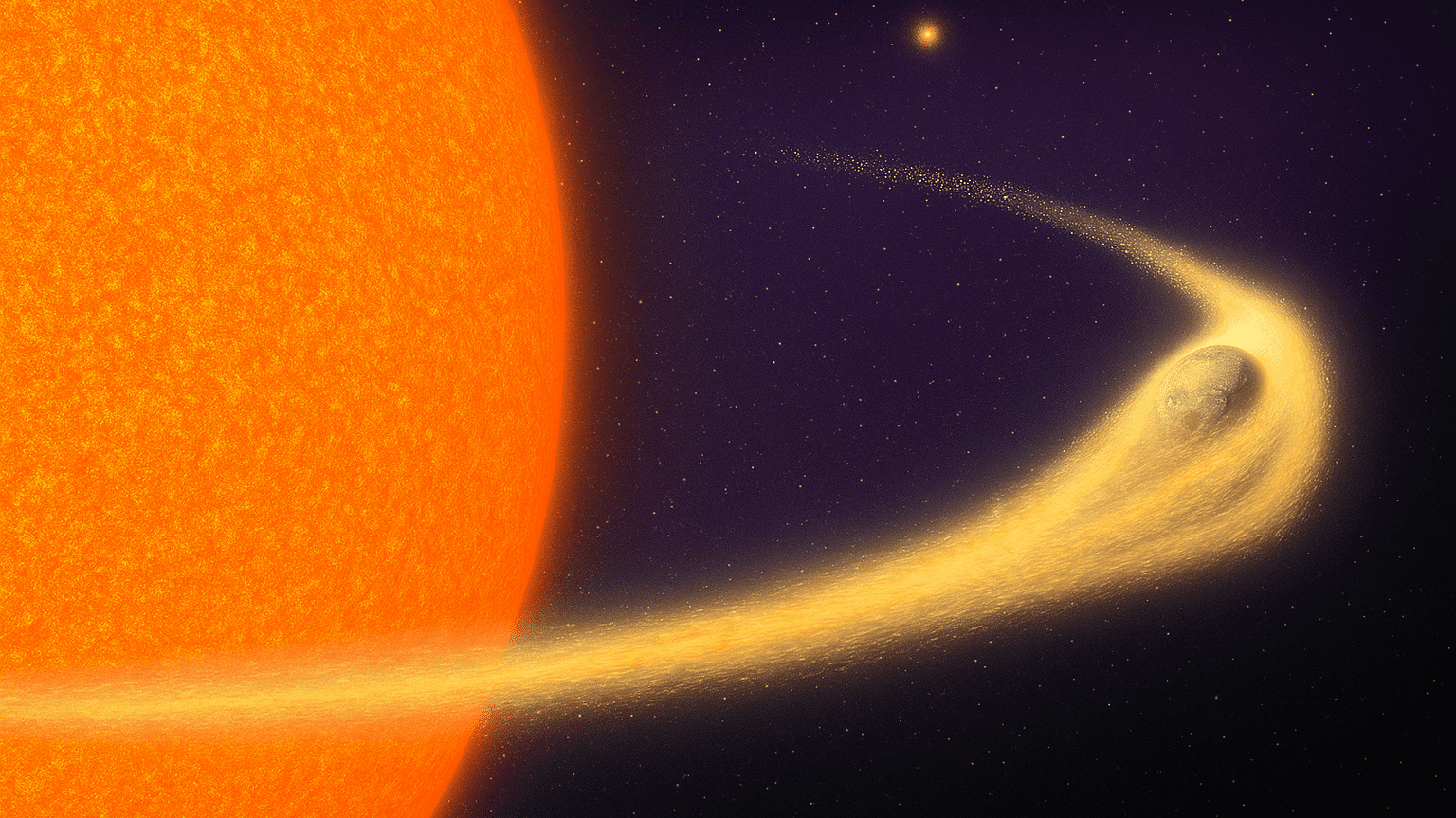
A planet is dying before our eyes, its body melting, vaporizing, and stretching into space like a ghostly trail over 5 million miles long.
That is not science fiction. It is what astronomers at MIT and around the world are witnessing right now, in real time. Using some of the most powerful telescopes on Earth and in space, they have discovered a strange, rocky planet named BD+05 4868 Ab. It is so close to its star that it is literally disintegrating, its surface burning away, forming a massive tail of dust, gas, and minerals that looks eerily like a comet. This planet is not the first of its kind to disintegrate, but it is by far the most observable thanks to the brightness of its host star and the dramatic clarity of its dusty tails. It is giving scientists an unprecedented look at how rocky planets lose their material under extreme conditions.
But how can a planet have a tail
The answer lies in the planet’s location. BD+05 4868 Ab is orbiting incredibly close to its host star—nearly 20 times closer than Mercury is to our Sun. This close proximity means the planet’s surface is being bombarded with intense stellar radiation. It is not just being heated—it is being vaporized. Solid rock on its surface is sublimating, turning directly from solid to gas. This vaporized material forms a trail of mineral grains that are swept away by the star’s radiation, producing a long, glowing arc behind the planet just like the tail of a comet.
Imagine placing a rock in front of a giant blowtorch. Now imagine that torch never turns off.
What is even more astonishing is the scale of this tail. Astronomers estimate it to be about 5.6 million miles long, so massive that it encircles more than half of the planet’s orbit. If we could stand near the star and look out, we might see the planet dragging a shimmering, mineral-rich ribbon across the sky. BD+05 4868 Ab is not only shedding dust. It is losing material from its surface layers—thin layers of rock and possibly volatile elements. At the current rate, it is losing about the mass of Earth’s Moon every million years, which suggests the entire planet could disintegrate over the next one to two million years.
So how did scientists discover something this wild
They first noticed something strange by monitoring tiny dips in the brightness of the planet’s star. Every time BD+05 4868 Ab passed in front of its star, it blocked some of the starlight. But the dips weren’t consistent. They varied in depth and duration and had asymmetrical shapes. That told astronomers that something irregular and extended—like a dusty tail—was crossing the star’s face, not just a round planet.
To confirm what they were seeing, researchers used a combination of telescopes, including NASA’s TESS space observatory and powerful ground based instruments like the Las Cumbres Observatory and Keck NIRC2. They pieced together a full picture of the planet’s transit patterns, dust cloud signatures, and orbital motion. What they found was a world disintegrating right in front of them.
This discovery gives scientists a rare chance to study how extreme radiation affects small rocky planets. It is like catching a process that usually takes billions of years and watching it unfold with every orbit. And because BD+05 4868 Ab orbits a bright star, scientists can use instruments like the James Webb Space Telescope to analyze the chemical composition of the material in its tail, offering insights into what this planet is made of deep inside.
In a way, BD+05 4868 Ab is giving up its secrets in its final breath.
This may not be a one-of-a-kind case. Other disintegrating planets have been found before, such as Kepler 1520b and K2 22b, but this one is brighter, clearer, and better suited for study. BD+05 4868 Ab is opening a window into planetary destruction that could help scientists understand not only how rocky planets die—but how they are built in the first place.
Some might wonder if Mercury, or even Earth, could meet a similar fate. But scientists say that is unlikely. These inner planets in our solar system have far greater mass and stronger gravity, which helps them retain their material even as the Sun ages. Still, BD+05 4868 Ab serves as a haunting reminder that in some star systems, planetary destruction is a natural part of evolution.
And thanks to ever watchful telescopes and the sharp eyes of astronomers, we are witnessing the slow collapse of a planet in real time—something no generation before ours has ever seen.


Leave a Reply