
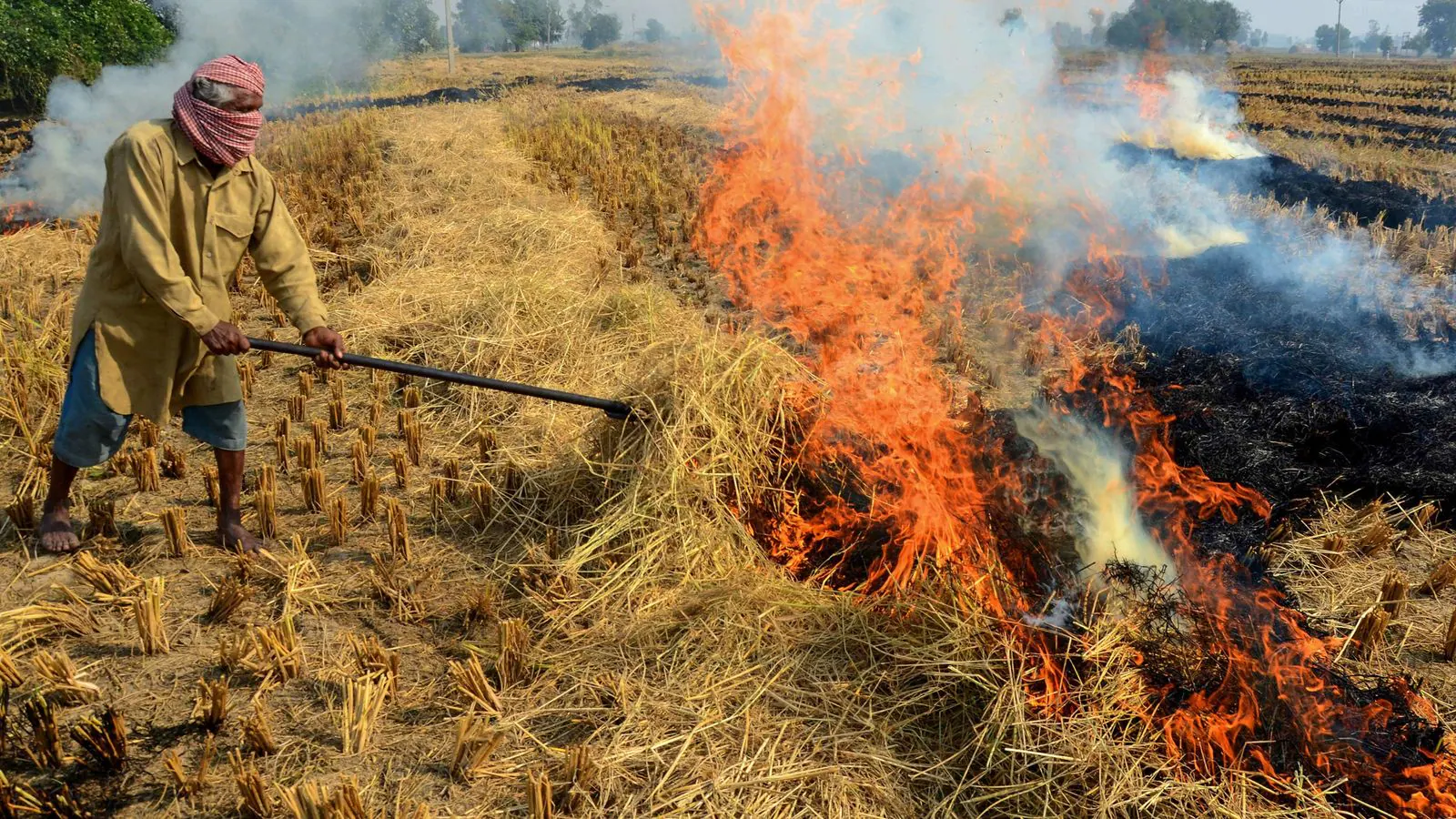
a suffocating haze blankets the region, leaving millions gasping for clean air. This toxic smog is not a natural phenomenon—it’s the result of human activity,
primarily stubble burning. Despite numerous government interventions, this age-old practice continues to choke the lungs of India and reduce the life expectancy of millions.
But why does this deadly practice persist, and can it ever be stopped?
The Practice of Stubble Burning
In agricultural hubs like Punjab, Haryana, and Uttar Pradesh, stubble burning is a quick solution for farmers needing to clear fields after the rice harvest
to prepare for wheat planting. This method involves burning leftover crop residue, or stubble, which can’t be plowed back into the soil.
India generates about 150 million tons of crop residue annually, with Punjab alone accounting for 20 million tons. Farmers, especially small-scale ones
who constitute 86% of India’s agricultural sector, often lack the financial resources or time to invest in alternative residue management practices.
With the narrow two-week window between crops, burning is often seen as the only viable option.
Yet, the impact of these fires stretches far beyond the fields, affecting the air, the economy, and human health.
The Deadly Consequences of Farm Fires
Health Impacts
The smoke from stubble burning contains hazardous pollutants, including PM2.5 particles, black carbon, and greenhouse gases like carbon dioxide and methane.
These pollutants contribute significantly to India’s already catastrophic air quality.
PM2.5 particles are particularly dangerous as they penetrate deep into the lungs and bloodstream, leading to respiratory and cardiovascular diseases.
In 2019 alone, air pollution was responsible for 1.67 million premature deaths in India. Delhi, with its chronic exposure to such pollutants,
has earned the grim title of the world’s most polluted capital for three consecutive years. According to the Energy Policy Institute at the University of Chicago,
the average Delhi resident loses 11.9 years of life expectancy due to sustained exposure to current air pollution levels.
Economic Costs
Air pollution costs India an estimated $36.8 billion annually in healthcare expenses and lost productivity. Farm fires exacerbate this burden every year,
affecting both rural and urban populations.
Environmental Damage
Beyond human health, stubble burning depletes soil fertility and water retention, forcing farmers to use more fertilizers and irrigation in the long run.
Each burning season contributes 149 million tons of CO₂ emissions, worsening global climate change.
Despite these devastating impacts, why hasn’t India managed to stop this deadly practice?
Government Efforts: Progress and Persistent Challenges
India has implemented several initiatives to curb stubble burning, including:
- Subsidies for Modern Machinery: Equipment like the Happy Seeder, which can plant wheat without clearing crop residue, has been subsidized by the government. Other tools, like balers that collect residue for repurposing, have also been promoted.
- Penalties and Incentives: Farmers face fines for burning stubble, and some are offered financial incentives to adopt sustainable methods.
- Satellite Monitoring: Satellite imagery now tracks farm fires in real time, helping authorities monitor and mitigate the practice.
While these measures have shown progress—farm fires have reduced by 30% in some regions—they haven’t fully addressed the issue. The reasons are complex:
- Small-scale farmers often find machinery costs prohibitive, even with subsidies.
- Contractors providing machinery services are scarce and overburdened during the short harvest window.
- Penalties are difficult to enforce uniformly, leading to inconsistent outcomes.
Without addressing these systemic issues, the cycle of stubble burning continues unabated.
Innovative Solutions: A Ray of Hope
To break this cycle, researchers and policymakers are exploring innovative alternatives to stubble burning:
- Natural Fungal Sprays: These sprays accelerate the decomposition of crop residue, turning it into fertilizer for the next planting season.
- Baling Machines: Baling machines collect and compress stubble, which can then be sold as biofuel, animal feed, or even raw material for paper production.
- Farmer Awareness Programs: Several non-governmental organizations (NGOs) and local governments are working to educate farmers about sustainable practices, highlighting case studies where alternatives have worked.
- Satellite Monitoring and Early Intervention: By using satellite data to predict high-risk zones, authorities can intervene earlier and provide farmers with resources before they resort to burning.
While these solutions offer hope, scaling them across millions of farms in India is a monumental challenge.
A Crisis of Complexity
Stubble burning is not just an environmental problem; it’s a socio-economic crisis rooted in the realities of small-scale farming. Any lasting solution will require a multifaceted approach: combining government support, technological innovation, and grassroots participation.
As the smog continues to darken Delhi’s skies, the urgency for action has never been greater. The health of millions—and the future of India’s air quality—depends on breaking this cycle of pollution.
Will we rise to the challenge, or will farm fires continue to burn away more than just stubble?