
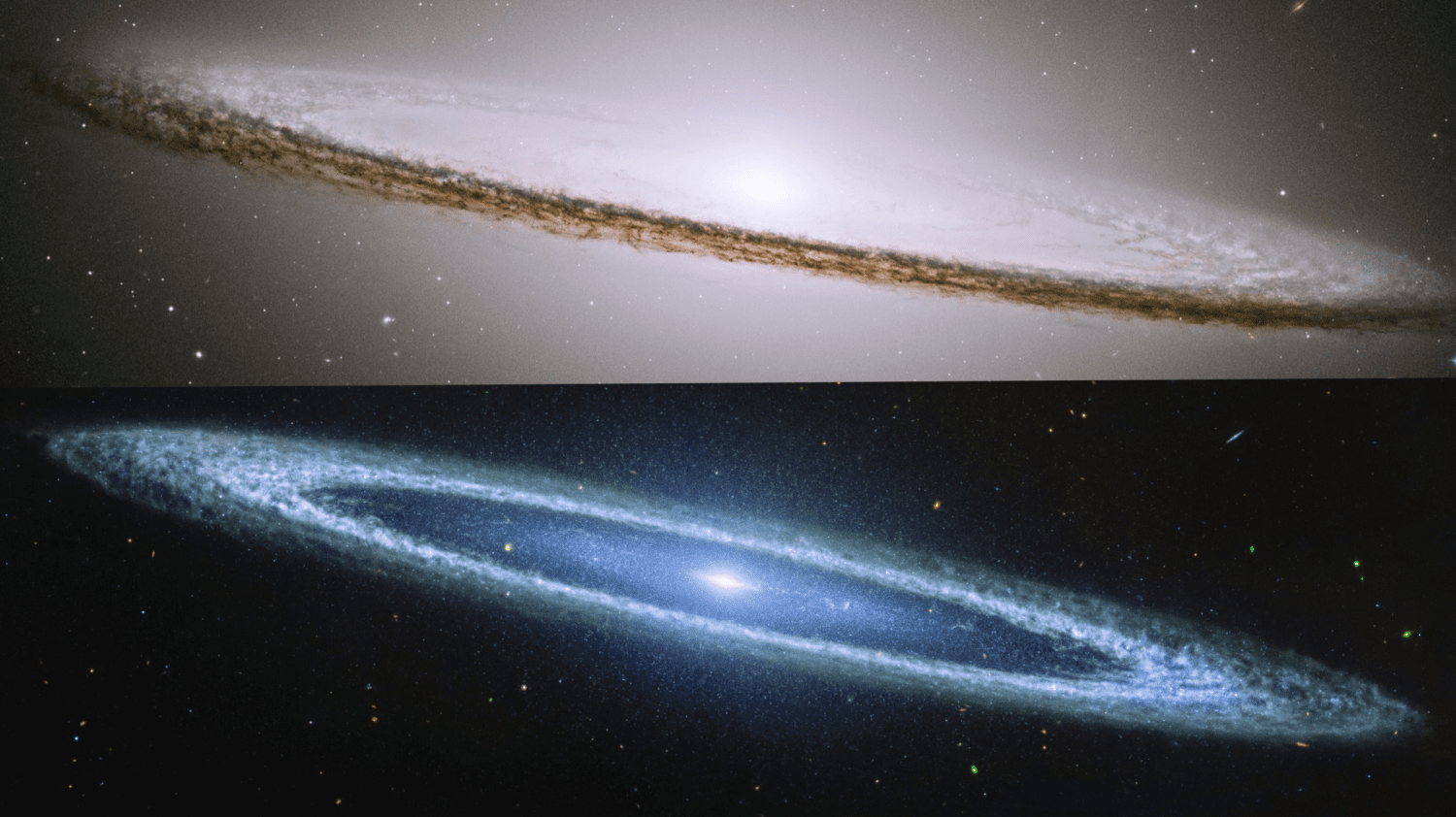
With its luminous core and wide, dark ring of dust, it’s a favorite for astronomers and stargazers alike.
But even the most familiar objects in space can surprise us.
Recent observations from the James Webb Space Telescope (JWST) have completely transformed our understanding of this galaxy.
What secrets did Webb uncover that Hubble missed?
A Tale of Two Telescopes
For decades, the Hubble Space Telescope provided the definitive image of the Sombrero Galaxy.
Its visible-light view showcased a bright, almost jewel-like central bulge surrounded by a smooth, dark ring of dust.
The galaxy’s resemblance to a wide-brimmed hat earned it the nickname “Sombrero.”
But the James Webb Space Telescope, armed with its powerful mid-infrared sensors, offered a completely new perspective.
Webb’s Mid-Infrared Instrument (MIRI) peered through the dust that obscures visible light, revealing something extraordinary.
What seemed to be a smooth, uniform dust ring in Hubble’s images was unveiled as a complex web of clumps and filaments.
These intricate structures suggest a far more dynamic and chaotic environment than previously imagined.
Why does this change everything we thought we knew about the Sombrero Galaxy?
Dust: The Galaxy’s Hidden Architect
The Sombrero Galaxy’s dust isn’t just for show—it’s an essential component in the formation of stars and planets.
Dust provides the raw materials for these cosmic phenomena, and its distribution tells astronomers where star formation is—or isn’t—occurring.
In Hubble’s images, the dust ring appeared smooth, leading scientists to assume it was relatively inactive.
Webb, however, shattered this assumption. The clumps and filaments revealed by its infrared view suggest pockets of activity that were hidden from view.
These regions could hold the key to understanding the galaxy’s evolutionary history.
Yet, for all its dust and potential star-forming regions, the Sombrero Galaxy’s star formation rate is surprisingly low—less than one solar mass per year.
For comparison, the Milky Way produces stars at twice that rate.
If there’s so much material, why is star formation in the Sombrero Galaxy so sluggish?
The Supermassive Black Hole: A Silent Giant
At the heart of the Sombrero Galaxy lies a supermassive black hole—a true cosmic giant.
Its mass is estimated to be an astounding 9 billion times that of the Sun, making it one of the largest known black holes in nearby galaxies.
To understand its scale, consider this: the Milky Way’s central black hole, Sagittarius A*, is 4.3 million times the Sun’s mass.
If the Sombrero’s black hole sat at the center of our solar system, its event horizon would stretch beyond Pluto’s orbit.
And yet, despite its monstrous size, the black hole is eerily quiet. Unlike the active black holes found in other galaxies,
which consume gas and dust at furious rates and emit powerful radiation, this one seems almost dormant.
Why would such a massive black hole be so inactive? Could it be biding its time, or are there forces at work we don’t yet understand?
Two Telescopes, One Incredible Discovery
The revelations about the Sombrero Galaxy highlight the importance of combining observations from Hubble and Webb.
Hubble’s visible-light image captured the galaxy’s luminous beauty, providing a sense of its overall structure.
Webb’s mid-infrared view, on the other hand, uncovered the hidden details: the intricate dust clumps, the subdued core,
and the clues to a more complex story.
This partnership between two of humanity’s greatest observatories is a testament to the power of collaboration.
Together, they provide a multi-dimensional view of the galaxy, allowing us to uncover secrets that neither could reveal alone.
But what other mysteries might this collaboration unveil in the future?
The Universe Is Full of Surprises
The Sombrero Galaxy’s clumpy dust ring and massive, yet silent, black hole are just the beginning.
Webb’s discoveries challenge long-held assumptions about this galaxy, reminding us that even the most studied objects in the cosmos can hold surprises.
Each new observation brings us closer to understanding the universe’s most profound mysteries. As Webb continues to explore, we can only wonder:
What other secrets lie hidden among the stars, waiting for discovery?