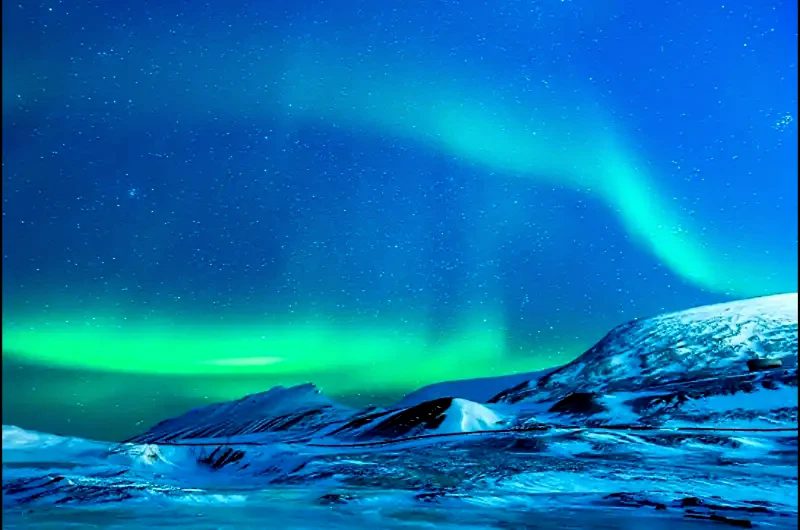
High above the Earth’s surface, where satellites orbit and solar energy crashes into our magnetic field, nature puts on a breathtaking show. The aurora, with its vivid waves of green, red, and purple, has long captivated humanity. But these dancing lights—especially the explosive bursts called auroral substorms—aren’t just for show. They unleash enormous energy into Earth’s upper atmosphere, particularly the thermosphere, a layer that plays a crucial role in everything from satellite trajectories to space weather patterns. Now, NASA is turning its attention skyward with the AWESOME mission—short for Auroral Waves Excited by Substorm Onset Magnetic Events—to understand how these substorms affect our planet at the molecular level.
Launched from the Poker Flat Research Range in Alaska, AWESOME is no ordinary space experiment. It’s an ambitious three-rocket campaign designed to solve a fundamental scientific mystery: What mechanism drives the large-scale mixing of gases in the middle and lower thermosphere—roughly 60 to 125 miles above Earth—during auroral substorms? The dominant theory has long suggested vertical convection: substorm energy heats the air, causing it to rise and mix. But lead investigator Mark Conde, a space physicist at the University of Alaska Fairbanks, believes the true drivers may be atmospheric waves—specifically acoustic-buoyancy waves—rippling through the thermosphere with the power to stir vast regions.
The mission’s launch window opened on March 24, 2025, and runs through April 6, weather and aurora activity permitting. The setup is carefully timed. Three rockets—a four-stage main rocket and two smaller two-stage rockets—will be launched in rapid succession, ideally just as a substorm is beginning. Each carries a payload of instruments and vapor tracers that will be released at different altitudes. These tracers will create glowing trails in the sky, allowing scientists to visualize wind patterns and detect atmospheric waves in real time.
The main rocket will travel highest, releasing its vapor near 160 miles altitude. The two smaller rockets will cover lower ranges, around 60 to 90 miles, to provide a vertical profile of the atmosphere’s response to a substorm. Meanwhile, teams of students and researchers stationed across Alaska—from Utqiaġvik to Venetie—will use sensitive cameras to track the tracers against the backdrop of the aurora. This coordinated effort aims to capture the full 3D motion of the disturbed atmosphere—essential data to determine whether it’s heat-driven convection or waves doing the stirring.
Why does this matter? The thermosphere plays a key role in space weather, affecting everything from GPS accuracy to satellite orbits. When auroral substorms release energy, they can heat and expand this atmospheric layer, causing satellites to experience more drag. Predicting these effects depends on knowing how energy spreads through the thermosphere. If waves—rather than localized heating—carry energy far from the aurora’s immediate zone, existing models may need a serious update. According to Conde and his team, this could enhance our ability to forecast disruptions during periods of high solar activity, like the solar maximum expected in 2025.
The beauty of AWESOME isn’t just in its name or its visual spectacle—it’s in its scientific ambition. By testing a long-standing theory with high-precision tools and coordinated rocket launches, the mission bridges observational science and atmospheric modeling in a way few experiments do. If the data confirm the wave hypothesis, it could reshape how scientists understand not just auroras but the broader interactions between the Earth’s magnetic field and atmosphere.
As of March 25, 2025, the mission team is on standby, monitoring auroral activity and weather conditions to ensure an optimal launch. The timing must be just right—catch the substorm too early or too late, and the window for meaningful data closes. But when the conditions align, the spectacle of tracer clouds glowing under the northern lights may not only awe observers but also reveal secrets locked in the upper reaches of our atmosphere.
NASA’s AWESOME mission is a reminder that even the most beautiful phenomena on Earth can have hidden complexities—and that the sky, far from being the limit, is a gateway to deeper understanding.