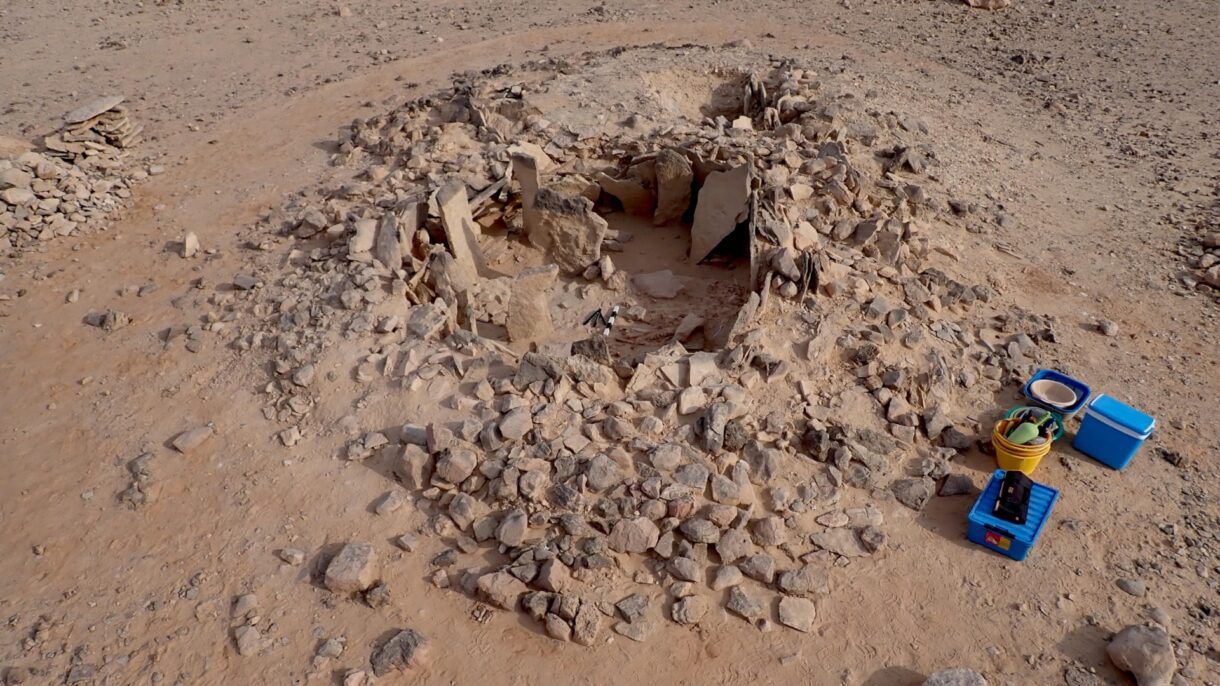
The deserts of Oman stretch across the land like a vast, silent ocean of sand and rock, a place where survival itself seems like a monumental achievement. We often imagine the earliest inhabitants of such landscapes as small, scattered groups, clinging to a fragile existence by hunting sparse game and gathering whatever edible plants they could find. We think of the slow, steady march towards agriculture as the one true path to stability and growth. But what if a community, seven thousand years ago, found a different way to thrive? What if their secret to success wasn’t rooted in the soil beneath their feet, but in the deep, blue waters of the distant Arabian Sea? Deep within the arid valleys of Wadi Nafūn, an extraordinary discovery has rewritten the story of Neolithic life in Southern Arabia. Archaeologists uncovered a monumental stone tomb, a megalithic structure that stood as a silent testament to a forgotten people. For over three hundred years, this single place served as the final resting point for an entire community, holding the remains of more than seventy individuals, from the very young to the old. As researchers began to piece together the lives of those buried within, they found clues that pointed not to the desert, but to the ocean. Among the human bones lay beautifully crafted fish hooks made of bone, sharp stingray barbs, and most surprisingly, pendants and loose teeth from formidable tiger sharks. These artifacts were more than just tools or ornaments; they were the first hint of a culture deeply intertwined with the marine world. But the most profound evidence was yet to be found, hidden within the very bones of the people themselves. Using a technique called stable isotope analysis, scientists were able to read the chemical history of their diet. This method examines elements like nitrogen preserved in bone and teeth, which reveal what a person ate throughout their life. The results were astonishing. The nitrogen values were unusually high, far higher than what would be expected from a diet of land animals or even common fish. This distinct chemical signature points to only one source: the regular consumption of apex predators, animals that sit at the very top of the food chain. These Neolithic people, living miles inland in the desert, were systematically hunting and eating sharks. This revelation changes everything we thought we knew about their society. They were not merely surviving; they were masters of a complex and demanding subsistence strategy. The evidence suggests these communities were not stationary. They likely moved between the inland valleys and the coast, establishing seasonal routes or sophisticated exchange networks. This mobility allowed them to exploit two vastly different environments with remarkable efficiency. They combined hunting and gathering in the desert with specialized, high-stakes hunting in the sea, creating a resilient and diverse way of life long before agriculture became widespread in the region. This discovery shatters the image of early desert dwellers as marginal or struggling. Instead, it reveals a community with a deep understanding of their world, possessing the skills and courage to pursue one of the ocean’s most powerful creatures. The presence of shark teeth as both tools and personal adornments also suggests that these animals were not just a source of food, but held a significant place in their culture and belief systems. As we learn more about these ancient people, a new picture of the past emerges, one filled with ingenuity and surprising connections. According to research from the Archaeological Institute of the Czech Academy of Sciences published in the journal Antiquity, this site provides the earliest direct evidence of systematic shark exploitation in the entire arid belt of the Old World. It reminds us that the path of human progress is not a single, straight line, but a rich tapestry of different adaptations and brilliant solutions to the timeless challenge of existence. And somewhere, beneath the sands of Oman, the story of the desert shark hunters lay waiting to be told.
Oman’s Ancient Desert Hunters: A 7,000-Year-Old Tale of Sharks and Survival