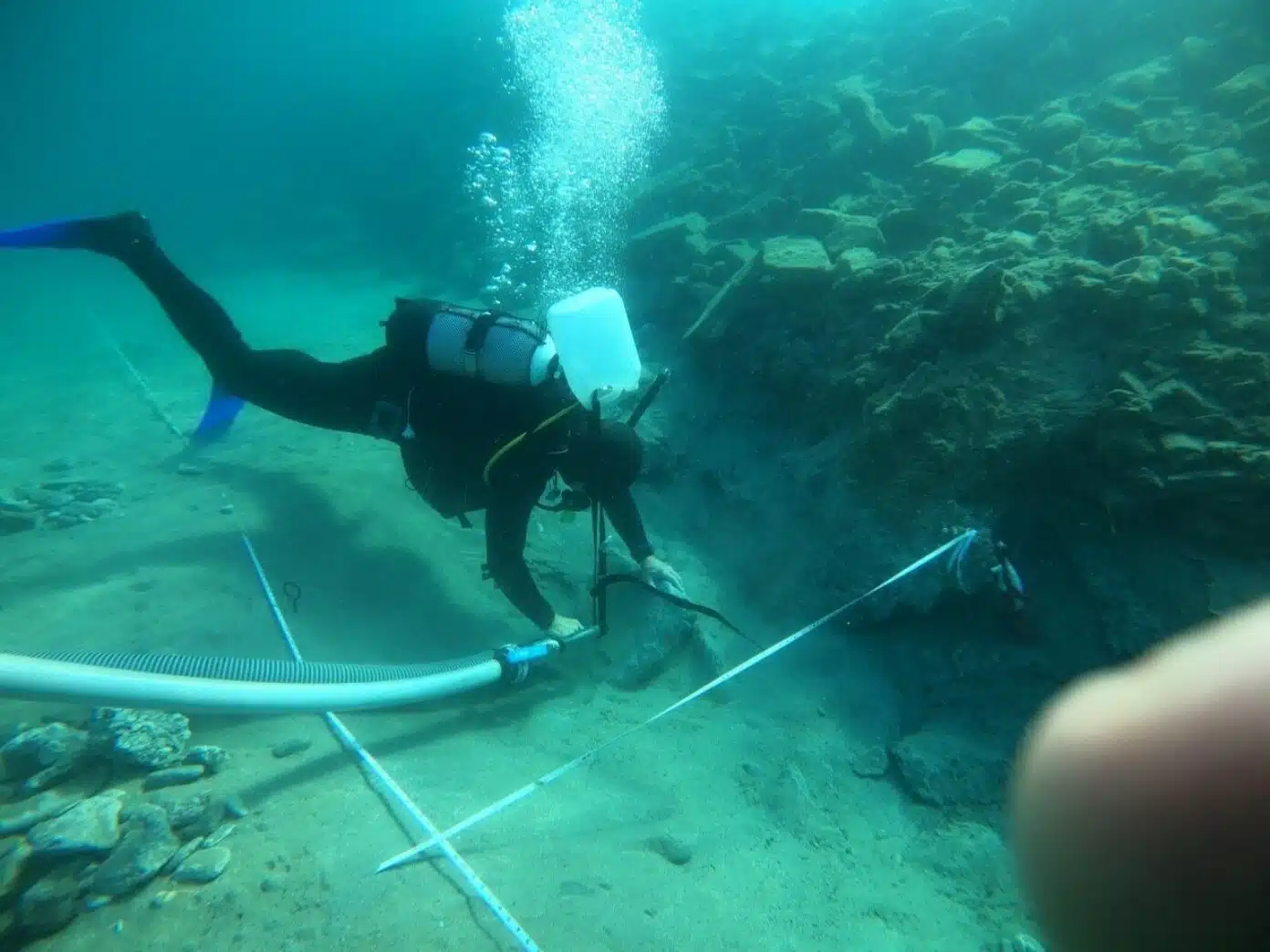
Beneath the coastal waters near Asini, Greece, archaeologists have uncovered the remains of a submerged ancient port, offering remarkable insights into Greece’s maritime history. This discovery, made possible through a collaboration between Greek and Swedish researchers, reveals an extensive harbor structure that once played a crucial role in ancient trade and naval activity. Using advanced underwater imaging and photogrammetry, the team has meticulously documented a submerged artificial platform, along with stone foundations, construction materials, and ceramic artifacts, shedding light on the region’s rich commercial and seafaring past.
The archaeological team, led by Greek and Swedish experts, focused their research on a 16-square-meter section of the site, where they identified key structural elements suggesting a well-planned and multifunctional port. Among the most notable finds were fragments of amphorae embedded within the stone structures, as well as a broken vessel found in one of the excavation sectors. These artifacts hint at commercial exchanges and maritime connectivity between Asini and other ancient Mediterranean civilizations.
Asini has a long and layered history, with evidence of occupation stretching from prehistoric times through the Mycenaean, Archaic, Hellenistic, and Roman periods. While the precise dating of the submerged port remains uncertain, the findings strengthen the hypothesis that this infrastructure played a vital role in facilitating maritime trade across multiple historical epochs. Previous research had already indicated the extensive nature of the port, with the main structure consisting of a large artificial platform in shallow waters, possibly featuring rooms or buildings that served both economic and strategic purposes.

The gradual collapse and submersion of the port appear to have been driven by geological shifts, sea level rise, and natural erosion, processes that have claimed many ancient coastal settlements over millennia. Given its strategic location along the Argolic Gulf, the harbor likely functioned as a hub for trade, fishing, and naval logistics, potentially even serving military or diplomatic functions during different historical periods.
Moving forward, archaeologists plan to expand the excavation, using sediment removal techniques and 3D imaging technology to uncover more of the platform’s upper sections and additional submerged structures. Future studies will focus on analyzing the ceramic fragments and other recovered artifacts to establish a more precise timeline for the port’s construction and usage. The results of these investigations will not only enhance our understanding of ancient Greek maritime networks but also contribute to the preservation and study of Greece’s underwater cultural heritage.
This extraordinary discovery highlights the importance of underwater archaeology in uncovering lost civilizations and forgotten histories. As technology continues to evolve, new methods will enable researchers to explore even deeper sections of submerged ruins, potentially revealing more secrets of ancient seafaring and trade networks. The findings at Asini serve as a reminder of the enduring legacy of maritime societies and the intricate connections that shaped the ancient Mediterranean world.