This ship sunk within 55 minutes and took with it a story the sea kept buried for over a century. HMHS Britannic, Titanic’s sister ship, met its fate on November 21, 1916, when it struck a German mine in the Aegean Sea near Kea Island. Unlike its famous sibling that battled an iceberg, Britannic faced a different enemy during World War I.
The misfortune struck while Britannic served as the world’s largest hospital ship. Originally designed as a luxury liner like Titanic, the ship had been converted to carry wounded soldiers and medical staff. That fateful morning, as it sailed through Greek waters with over 1,000 people aboard, an underwater mine tore into its hull. What followed was chaos. The captain tried desperately to beach the ship on nearby shores, but water flooded too quickly. In the panic, some lifeboats launched too early, drifting toward the ship’s massive propellers that were still turning. Thirty people died when two lifeboats got caught in those deadly blades, their occupants unable to escape the churning steel.
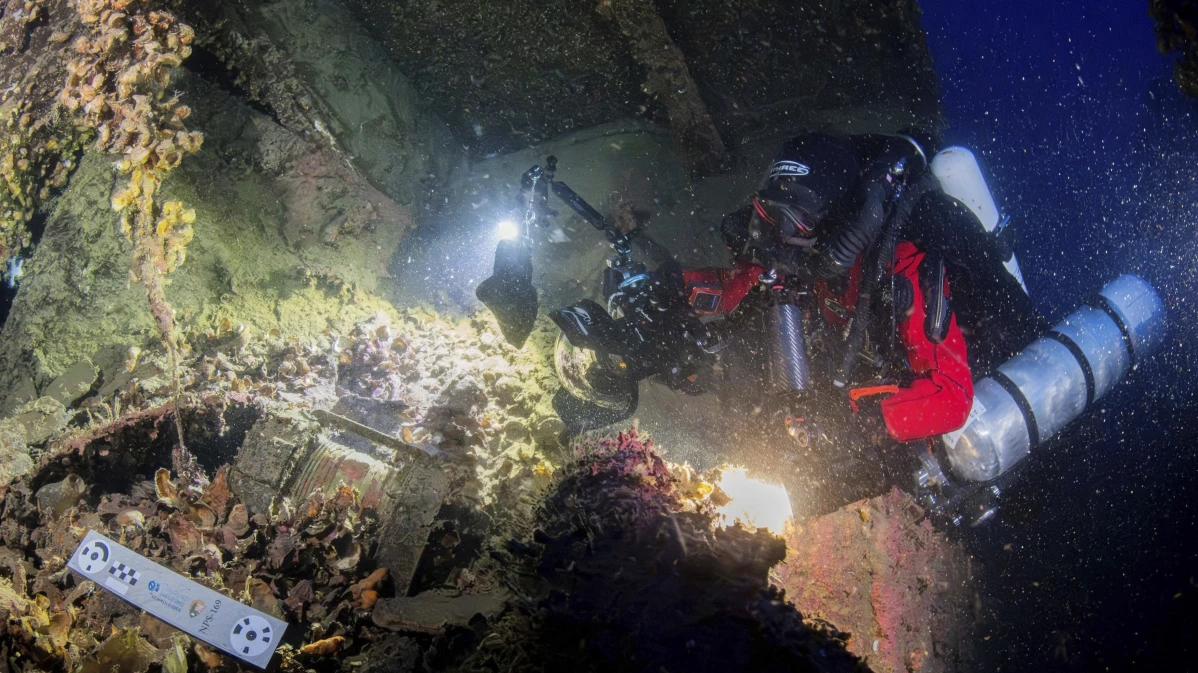
For 109 years, Britannic rested 400 feet below the surface, holding its secrets in the cold darkness. Then came May 2025, when everything changed. A team of eleven expert divers, working under Greece’s cultural authorities, descended to the wreck for the first official artifact recovery mission. Using specialized breathing equipment and careful lifting techniques, they brought up pieces of history that hadn’t seen sunlight since that November morning in 1916.
The treasures they recovered tell powerful stories. The ship’s bronze bell, which once called crews to stations during emergencies, emerged from the depths covered in marine growth but intact. A port navigation light that guided the vessel through dark waters returned to the surface, along with passenger binoculars that once scanned horizons for safety. These weren’t just random objects but carefully selected pieces that represented both the ship’s luxury origins and its wartime service.
Working in dangerous conditions with strong currents and limited visibility, the dive team also recovered ceramic tiles from a Turkish bath, silver serving trays, and a porcelain sink from second-class accommodations. Each item underwent immediate conservation treatment in Athens laboratories, where specialists began the delicate process of removing decades of salt and marine deposits.
The future holds promise for these rescued artifacts. After full conservation, they will find a permanent home in Piraeus at Greece’s new Museum of Underwater Antiquities. The bell, navigation light, and other recovered pieces will anchor a World War I exhibition that transforms Britannic from a forgotten sister ship into a centerpiece of maritime history. Visitors will stand face to face with objects that witnessed both luxury and tragedy, peace and war, life and sudden death.
This recovery marks more than just archaeological success. It connects us directly to a ship that served humanity during its darkest hours, only to become another casualty of global conflict. Through these artifacts, Britannic finally gets to tell its own story, separate from Titanic’s shadow, reminding us that even sister ships can have dramatically different tales to tell.
Source: Britannic titanic shipwreck recovery