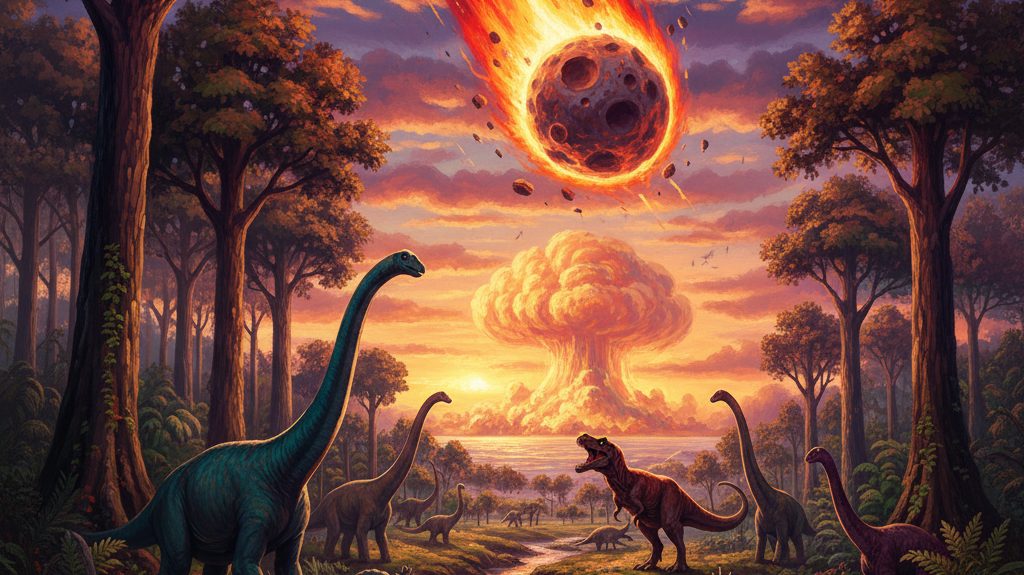
Sixty-six million years ago, a streak of cosmic fate collided with our planet and rewrote life’s story forever. The object in question was a 7-miles (12 kilometers) wide asteroid hurtling through space at blinding speed, drawn straight toward what is now the Yucatán Peninsula. The moment it struck, the world changed in ways hardly imaginable today. The explosion unleashed more energy than any human-made device, erasing nearly all traces of its own presence in a flash hotter and more violent than anything Earth had ever experienced.
Scientists long wondered what became of the asteroid that triggered this extinction event.
Most of it didn’t survive the collision. The incredible heat and force instantly vaporized the asteroid, atomizing its material into a fine mist that was thrust into the upper atmosphere. This is where the story leaves a tangible mark: a thin layer of the element iridium, rare on Earth but abundant in asteroids, that was dispersed globally. This layer can still be found in rock columns worldwide, a silent witness marking the end of the dinosaur age and the fifth great extinction.
Occasionally, researchers unearth fragments even smaller than a sesame seed. These rare meteorite bits, retrieved from deep-sea cores or ancient sediments, are all that’s left of the original asteroid. While hopes remain of finding a larger chunk, the odds are vanishingly small. The violence of the collision both forged and erased history in a single moment, leaving behind a crater more than 100 miles wide, the Chicxulub crater, most of which now hides below the Gulf of Mexico. Even today, the rim of this titanic wound can be glimpsed as a series of oddly aligned sinkholes and ancient rock formations.
The impact did not merely reshape rock and land. It triggered a mile-high tsunami that scoured ocean floors, carving out megaripples as tall as buildings. Shockwaves raced through the crust, igniting wildfires and conjuring up storms of acid rain. But the deadliest consequence wasn’t immediate. The asteroid’s vaporized remains, along with a massive amount of sulfur from the impact site, blocked sunlight, plunging Earth into years of darkness. The resulting “nuclear winter” collapsed food chains, snuffed out plant life, and doomed three out of every four species to extinction. Only a resilient few, including the ancestors of today’s birds, survived to fill the niches left vacant by vanished giants.
For modern scientists, the puzzle of the dinosaur-killing asteroid is a story assembled from tiny clues: iridium streaks, microscopic fragments, and an enormous crater hidden by ocean and time. Though the planet has erased nearly every physical trace of this ancient visitor, its impact remains written in stone, fossils, and the DNA of every living thing.
What happened to the asteroid is a tale of utter destruction, and the beginning of something entirely new.