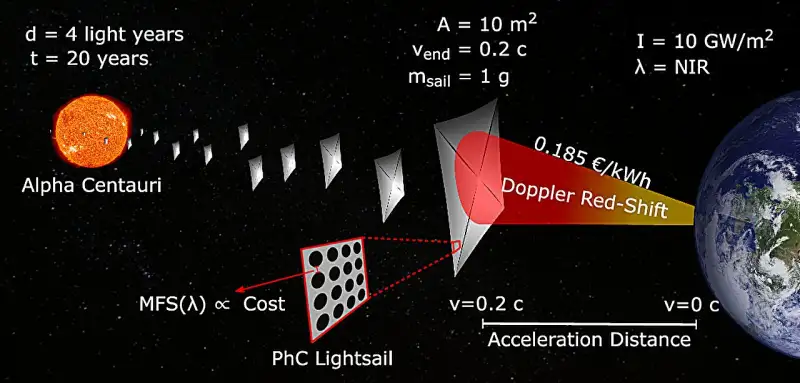
Imagine a spacecraft gliding through the cosmos, powered not by engines or propellants, but by light itself. Once the realm of science fiction, this vision is rapidly moving toward scientific reality thanks to a remarkable breakthrough by researchers from Brown University and Delft University of Technology (TU Delft). Their newly unveiled lightsail design—a featherlight, ultra-reflective membrane engineered at the nanoscale—could one day enable interstellar travel at unprecedented speeds. Detailed in a study published in Nature Communications, this innovation combines advanced materials science with cutting-edge artificial intelligence to bring humanity one step closer to exploring the stars.
At the heart of this advancement is the principle of photon propulsion. Lightsails work by capturing momentum from particles of light—photons—and using it to gradually accelerate a spacecraft. While the force exerted by individual photons is minuscule, the cumulative effect over long durations in space could push lightweight probes to a fraction of the speed of light. This concept is not new; scientists and science fiction writers alike have championed it for decades. But the technical barriers—creating sails that are both incredibly lightweight and highly reflective—have remained daunting. The team from Brown and TU Delft has now cleared one of the biggest hurdles.
Their lightsail is a silicon nitride membrane measuring 60 millimeters on each side—about the size of a sticky note—but only 200 nanometers thick, making it roughly a thousand times thinner than a human hair. What sets this sail apart is its surface, which is etched with billions of nanoscale holes. These holes are not randomly placed. Each is smaller than the wavelength of light and strategically positioned to reduce mass and enhance reflectivity, ensuring that more photon energy is reflected rather than absorbed as heat. This dual benefit means the sail can be accelerated more efficiently while withstanding the stress of high-powered laser propulsion.
Creating such a precise pattern at this scale would traditionally take years of trial and error, but the Brown team, led by Associate Professor Miguel Bessa, developed a novel AI-driven approach to optimize the design. Using neural networks and a method called topology optimization, the team trained their algorithm to find the perfect arrangement of holes that would maximize optical performance without compromising structural integrity. What might have taken human researchers months or even years to simulate and test was completed by AI in a fraction of the time.
Once the optimal design was generated, it was handed off to the experimental team at TU Delft, led by Associate Professor Richard Norte. Here, another layer of innovation unfolded. Fabricating such an intricate and fragile structure at nanoscale would typically require costly, time-intensive methods. But Norte’s team developed a new gas-based etching process that removes the material beneath the sail, allowing the delicate membrane to remain suspended. This process took just one day to complete—a dramatic improvement over traditional nanofabrication timelines—and cut costs by several orders of magnitude. Despite their fragile appearance, the completed sails were surprisingly durable and stable once suspended.
This design not only overcomes key engineering limitations but also demonstrates real-world feasibility. While the lightsail tested in this study is still small-scale, its centimeter-wide footprint already marks a significant leap over previous models, many of which were either too tiny or too unstable for meaningful testing. Scaling it up to meter-sized sails—the dimensions likely needed for interstellar missions—is now a tantalizing possibility.
So why is this breakthrough so important? Consider the current state of interstellar exploration. NASA’s Voyager 1, the farthest human-made object from Earth, has taken nearly 50 years to travel just over 15 billion miles—still less than 0.1% of the distance to Alpha Centauri, our nearest star system. At its current pace, it would take more than 70,000 years to get there. But with a lightsail propelled by high-powered lasers, a probe could make the journey in just a few decades. The team’s new design significantly advances this vision, offering a lightweight, scalable solution that could transform deep space missions from a distant dream to a plausible goal.
In practical terms, such a lightsail could carry microchip-sized probes to nearby stars, riding a beam of light at speeds up to 20% of the speed of light. This aligns with the goals of the Breakthrough Starshot Initiative, which envisions sending fleets of these probes to nearby exoplanets to collect data and beam it back to Earth. The lightsail developed by Brown and TU Delft could be a vital component of this ambitious plan, bringing both feasibility and efficiency to the forefront.
Beyond space exploration, this technology has implications for nanotechnology, materials science, and engineering at large. The same principles that make the sail ultra-light and highly efficient could be adapted for advanced sensors, optical devices, or experimental platforms in quantum research. The team’s ability to manipulate matter at the atomic level, guided by AI, opens a new chapter in precision engineering.
Challenges remain, of course. Scaling the sail to mission-ready sizes will require even more refined fabrication techniques, and the infrastructure to generate and focus the high-powered laser beams needed for propulsion must be developed. The sails will also need to withstand the harsh realities of space—micrometeoroids, cosmic radiation, and extreme temperature fluctuations. But the current results are deeply promising.
As the Brown and TU Delft researchers continue refining their design, they’re also planning experimental tests that could push these sails across measurable distances here on Earth—against gravity, using laser light. One of their short-term goals is to push a sail a full centimeter using light alone, a seemingly small but unprecedented leap that would exceed any previous laser-pushed object by orders of magnitude.
This lightsail isn’t just a material—it’s a symbol. A symbol of what can be achieved when cutting-edge physics, machine learning, and visionary ambition come together. As noted in the official statements from both universities, this is just the beginning. The cosmos may be vast, but with sails this light and technology this smart, we may soon find ourselves riding beams of light into its farthest reaches.